
Radiesse vs Sculptra: Which Suits Your Treatment Goals?
Radiesse vs Sculptra are injectable biostimulatory treatments used for facial volume, contour and skin quality concerns. Radiesse is often considered for more immediate support and definition, while Sculptra usually works gradually by supporting collagen over weeks to months. The better option depends on your anatomy, treatment area, timeline and consultation goals.
Radiesse vs Sculptra: What should you know?
Radiesse and Sculptra are both injectable biostimulatory treatments used to improve facial volume, contour, and skin quality. They work in different ways and suit different treatment goals depending on anatomy, timing, and desired outcome. Choosing between them is not about which is better, but which approach matches your needs.
- Radiesse is often introduced as a calcium hydroxylapatite (CaHA) injectable that provides more immediate structural support. It is commonly considered when contour, definition, or targeted facial support is the main goal. The effect combines early support with longer-term tissue response.
- Sculptra is a poly-L-lactic acid (PLLA) injectable that works more gradually by stimulating collagen over time. It is usually introduced as a treatment for broader volume loss and skin quality changes. Results develop slowly over several weeks and are assessed in stages rather than immediately.
Key distinctions between Radiesse and Sculptra
Radiesse and Sculptra is best understood as a difference between more immediate structural support and gradual collagen stimulation. Radiesse is commonly considered when contour, definition or support is the main goal. Sculptra is commonly considered when broader facial volume loss or progressive collagen support is the priority.
Comparison point | Radiesse | Sculptra |
Main ingredient | Also known as CaHA (calcium hydroxylapatite) | PLLA (poly-L-lactic acid) is called |
Product form | Gel carrier containing CaHA particles | Dry powder reconstituted before injection |
How it works | Supports tissue and stimulates soft tissue response | Promotes collagen-building over time |
Result timing | Some support may be visible earlier | Progressive change over several weeks to months |
Best-fit goals | Contour, support, definition | Broad volume restoration, skin quality |
Common areas | Jawline, cheeks, hands, nasolabial folds | Cheeks, facial wrinkles, volume loss |
Sessions | Often planned by area and syringe amount | Often delivered as a treatment series |
Longevity planning | Varies by area, dose and patient | Often discussed as longer-term collagen support |
Reversibility | Not dissolved like HA filler | Not dissolved like HA filler |
Downtime | Swelling, bruising, or tenderness can happen | Swelling, bruising, and tenderness are potential effects |
Cost planning | Depends on area and product amount | Depends on vials and number of sessions |
Safety notes | Requires trained anatomical placement | Requires correct depth and spacing |
Radiesse may suit patients wanting more immediate contour or structural support, while Sculptra may suit patients wanting gradual, broad collagen support. The better option is not universal because each face has different bone structure, soft tissue thickness, skin quality and tolerance for staged treatment.
Immediate contour vs gradual collagen-building
Radiesse contains CaHA particles in a gel carrier, so it can provide support while also encouraging longer-term tissue response. Sculptra is reconstituted before treatment and relies on progressive collagen stimulation, so it is generally assessed over a longer timeline.
This difference matters when you care about timing. Radiesse may be more suitable when the plan needs visible support earlier. Sculptra may be more suitable when you prefer progressive change and are willing to complete a series.
Structured definition vs soft global volume
Radiesse often suits treatment plans that need structured definition, such as jawline support, selected cheek contour or lower-face support. Sculptra often suits broader volume changes, especially when facial thinning affects multiple areas.
The finish can also feel different. Radiesse is often discussed as more contour-focused. Sculptra is often discussed as softer and more global, because the result develops as collagen response builds.
A natural-looking result can come from either option. The result depends less on the product name and more on the match between product, anatomy, dose, depth and injector technique.
Number of treatments and ongoing maintenance plan
Radiesse is often planned by treatment area and syringe amount. Sculptra is often planned by vial amount and a treatment series, with reviews spaced so the clinician can assess gradual response.
The Sculptra IFU states that the number of injection sessions and amount used depend on the patient’s need, with four-week intervals between sessions referenced in patient counselling information.
Cost and maintenance should therefore be discussed as a total plan, not a single product unit. A lower unit price doesn’t always mean lower total cost.
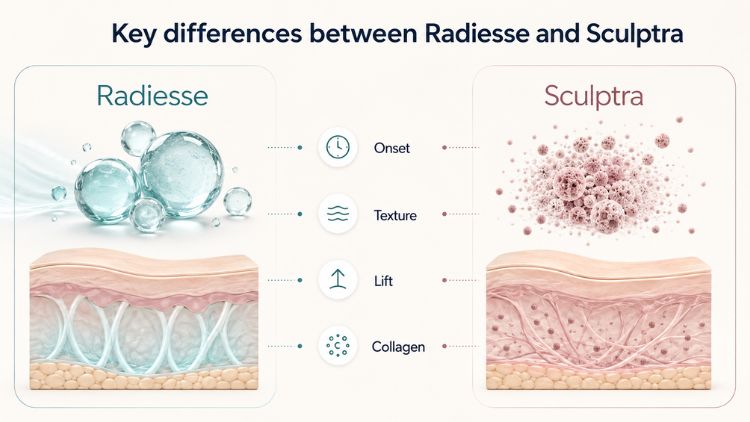
Comparison table showing Radiesse versus Sculptra key differences
Treatment areas: Jawline, cheeks, temples, hands and neck
The suitability of Radiesse or Sculptra depends on the treatment area, as each zone has distinct structural and aesthetic requirements.
Concern | Radiesse may be considered | Sculptra may be considered | Consultation note |
Jawline definition | Often more relevant | Sometimes indirect support | Check bone, laxity and tissue thickness |
Cheek support | Can support contour | Can support gradual fullness | Choose based on shape goal |
Temples | Usually cautious | Often discussed for hollowing | Needs careful vascular assessment |
Hands | Listed indication in AU IFU | Less commonly discussed | Assess veins, tendons and skin quality |
Neck quality | Diluted plans may be discussed | May be discussed in selected plans | Avoid assuming suitability |
Avoid assuming suitability | Often not first choice | Caution needed | Placement depth matters |
Radiesse and Sculptra both require anatomical precision. This is especially important around vessels, thin tissue, previous surgical areas or areas with limited soft tissue support.
Radiesse vs Sculptra: Which has longer results?
Sculptra is often discussed as a longer-term collagen stimulator. Galderma describes a typical plan as about three sessions over a few months, with results that can last up to two years. Radiesse longevity varies by area, product amount and treatment plan, so the better question is which duration suits your anatomy and risk tolerance.
Radiesse longevity factors
Radiesse longevity depends on the treatment area, product amount, tissue movement, injection depth, metabolism, lifestyle and review plan. The Australian IFU also notes that safety of Radiesse beyond three years in the face and one year in the hands has not been investigated in clinical trials.
A firmer product may be helpful in one area and unsuitable in another. For example, a jawline plan has different movement, skin thickness and structural needs compared with a nasolabial fold or hand plan.
TAEGA will usually discuss the goal first, then the maintenance plan. Some patients need only a focused area reviewed. Others may benefit from staged support across several visits.
Sculptra longevity factors
Sculptra longevity depends on whether enough sessions are completed, how your body responds to collagen stimulation, and how volume loss changes over time. Galderma describes Sculptra as typically involving about three sessions over a few months, with results that can last up to two years.
Sculptra is not usually assessed after one early appointment. The Australian IFU notes that treatment effects appear gradually over a few weeks and that patients should be re-evaluated no sooner than four weeks after treatment.
This makes review appointments important. A careful plan avoids overcorrection and gives your clinician time to assess how your face is responding.
Why “longer-lasting” does not always mean “better”
A longer-lasting result is not automatically better. A product that lasts longer also requires more careful planning because it may be harder to adjust if the result does not suit your face, tissue or expectations.
Reversibility matters. Radiesse is not easily removed, according to its Australian IFU, and Sculptra is not dissolved like hyaluronic acid filler. Conservative treatment is therefore important for both options.
The better choice depends on your concern, anatomy, timeframe, comfort with gradual change and tolerance for staged treatment. During consultation, we will also explain when delaying treatment is the more sensible option.
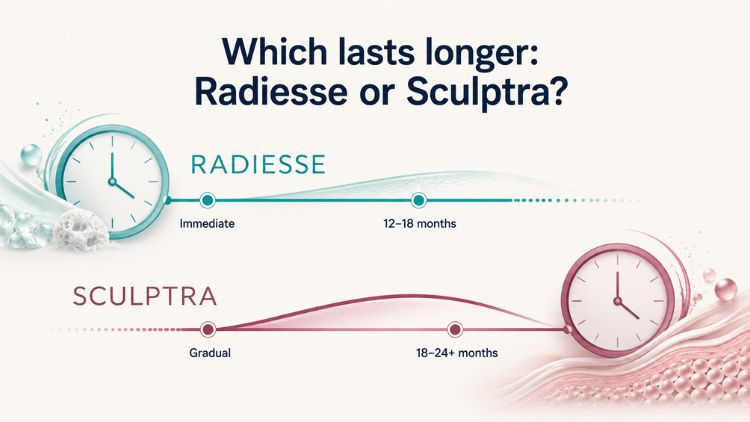
Longevity comparison between Radiesse and Sculptra injectable treatments
Safety, side effects and reversibility: What patients should understand
Radiesse and Sculptra can cause short-term injection effects such as swelling, bruising, redness, tenderness or lumps, and both require correct patient selection and anatomical placement. Rare but serious vascular complications are possible with soft tissue fillers, which is why trained injectors and conservative planning matter.
Common short-term effects
Common short-term effects may include swelling, bruising, redness, tenderness, discomfort, itching, firmness, lumps or temporary unevenness. These reactions are usually discussed before treatment because they can affect how your face looks and feels during the early settling period.
- The Radiesse Australian IFU lists injection-related reactions including bruising, erythema, swelling, pain, itching, discolouration and tenderness, which usually resolve spontaneously within one to two days.
- The Sculptra Australian IFU lists anticipated injection-procedure reactions including transient bleeding, pain, localised redness, bruising, haematoma or oedema, generally resolving within two to six days.
Nodules, vascular risks and product placement
Nodules, lumps and contour irregularities can occur when product choice, depth or patient response is not appropriate. Both products require careful placement because injecting too superficially or into the wrong plane can increase visible or palpable irregularities.
Although rare, vascular complications can be serious. Sculptra’s IFU warns that intravascular injection may lead to embolisation, occlusion, ischemia, infarction, vision impairment, blindness, stroke, skin necrosis or damage to underlying facial structures. Radiesse’s IFU includes similar warnings for vascular introduction.
This is why consultation is not a formality. TAEGA needs to assess your anatomy, medical history, previous treatments and treatment area before recommending any injectable plan.
Is it possible to reverse Radiesse and Sculptra?
Radiesse and Sculptra are not dissolved in the same way as hyaluronic acid fillers. Radiesse’s Australian IFU states that it can be added in later injections but cannot be easily removed, while Sculptra is a PLLA implant designed for gradual tissue response rather than immediate HA-style dissolution.
This does not mean complications cannot be managed. It means prevention matters. Conservative product selection, correct depth, careful dosing and early review are more important when a product is not easily dissolved.
If you have had previous injectables, bring those details to your appointment. The product type, timing and treatment area can influence the safest next step.
Who is not suitable for treatment right now?
You may need to delay or avoid treatment if you have active infection or inflammation in the treatment area, severe allergies, known hypersensitivity, bleeding disorders, pregnancy or breastfeeding, or a tendency toward keloid or hypertrophic scarring. The exact decision depends on the product and your medical history.
Sculptra’s Australian IFU states that safety in pregnancy, breastfeeding women and patients under 18 has not been established. It also notes that patients with unattainable expectations are not suitable candidates.
Radiesse’s Australian IFU states that safety and performance during pregnancy, breastfeeding or in patients under 18 has not been established. It also lists several contraindications that must be reviewed before treatment.
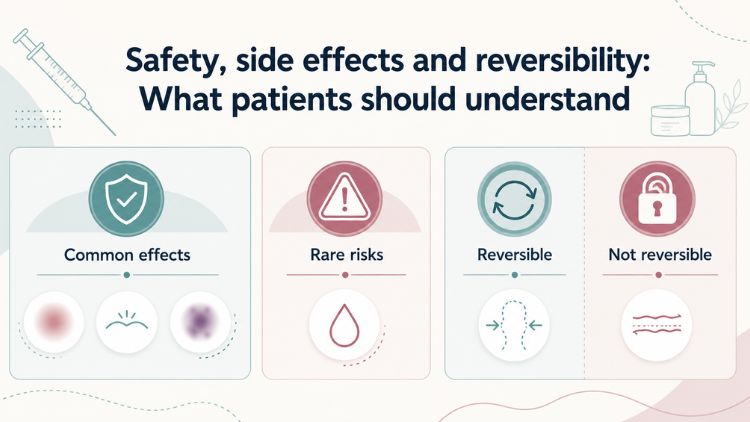
Safety risks side effects and reversibility of injectables
Who may suit Radiesse, Sculptra or neither?
Radiesse may suit patients who need support or definition, while Sculptra may suit patients who want gradual facial volume restoration across broader areas. Some patients may suit neither because their concern may need surgery, skin treatment, wrinkle reduction, medical review or no treatment at that time.
Consider Radiesse if your goal is definition or support
Radiesse may be considered when your main concern is contour, lower-face support or structural definition. This may include jawline, chin, selected cheek support, nasolabial folds, marionette lines or hand volume loss, depending on your assessment.
It may be more relevant if you want a defined treatment goal and your tissue can support that product safely. However, strong definition is not always the most natural-looking choice.
TAEGA will assess bone structure, soft tissue thickness, skin laxity and previous treatment history. If the area is too thin or mobile, we may discuss another option.
Consider Sculptra if your goal is gradual facial volume restoration
Sculptra may suit patients with broader facial thinning, temple hollowing, cheek volume change or gradual loss of facial support. It may also suit patients who prefer slower visible change and are comfortable with multiple appointments.
Sculptra is commonly planned as a series rather than a single quick result. Galderma describes a typical treatment approach as about three sessions over a few months, although the right number varies by patient.
This option may be less suitable if you need a visible change by a specific event. It may also be unsuitable if your medical history, scarring tendency or expectations make treatment higher risk.
Consider neither if your concern needs another approach
Neither Radiesse nor Sculptra may be appropriate if your concern is significant skin laxity, dynamic wrinkles, pigmentation, acne scarring, redness, poor skin texture or a concern that needs surgical opinion.
Dynamic wrinkles may need a different treatment category. Pigmentation and texture often respond better to skin treatments. Significant laxity may need a surgical or device-based discussion, depending on severity.
A good consultation should include the option of no treatment. If timing, safety or expectations are not right, delaying treatment can be the most appropriate recommendation.
When a combined or staged plan may make sense
Some patients may benefit from a staged plan that uses different treatment categories at different times. For example, one area may need structural support, while another may need gradual collagen stimulation or skin-quality treatment.
This does not mean more product is better. A combined plan should have a clear reason, a safe sequence and review points. It should also consider cost, downtime and how each treatment may interact with the next.
TAEGA’s role is to help you understand the options, not push you toward a product name. We will explain why a plan may suit your anatomy and where we would be cautious.
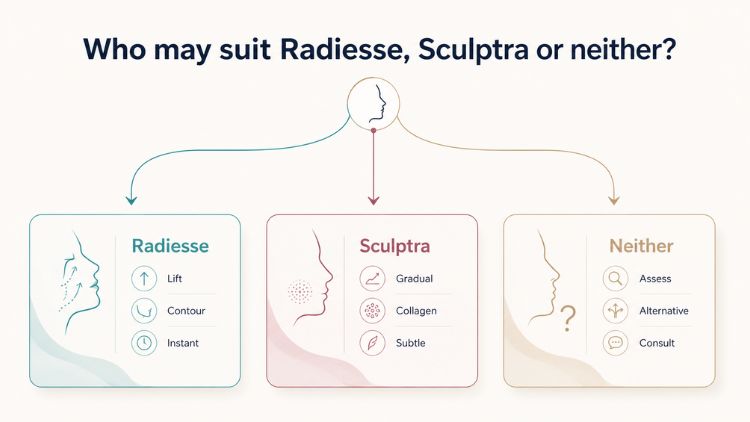
Patient suitability comparison for Radiesse and Sculptra treatments
Radiesse or Sculptra: Which works better?
Radiesse is not better than Sculptra for every patient, and Sculptra is not automatically the more natural option. Radiesse may be the better fit when you want focused support or definition. Sculptra may be the better fit when you want gradual collagen support and broader facial volume restoration.
- Radiesse is usually the better fit when the goal is focused structure, contour or support, such as jawline definition, chin support, cheek contour or hand volume loss. It may suit patients who want a more defined change in a specific area, but it still needs careful assessment because it is not dissolved like hyaluronic acid filler.
- Sculptra is usually the better fit when the goal is gradual collagen support and broader facial volume restoration, especially for facial thinning, cheek volume loss or temple hollowing. The better choice is not based on the product name alone; it depends on your anatomy, treatment area, timeline, medical history and whether you want a more structured or gradual result.
At TAEGA, we would not ask you to choose between Radiesse and Sculptra on your own. We first assess what has changed in your face, then explain whether your concern needs structure, gradual collagen support, skin treatment, another injectable category or no treatment at this stage.
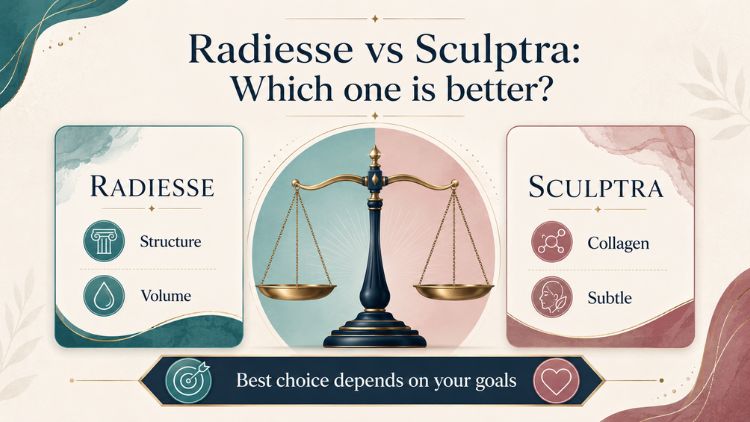
Choosing between Radiesse and Sculptra based on goals
How results develop over time
Radiesse and Sculptra results develop on different timelines. Radiesse may show earlier support because of its gel carrier and structural properties, while Sculptra is assessed more gradually because treatment effects appear over weeks and may require staged sessions before the final plan is reviewed.
Same day to first week
The first week is not the final result for either treatment. Swelling, bruising, tenderness and temporary fullness can make the treated area look or feel different while the tissue settles.
For Sculptra, early fullness can partly reflect fluid and swelling from the injection process. For Radiesse, early support may be more visible, but swelling can still affect the appearance.
Stick to the aftercare instructions given by your provider. If anything feels unusual after treatment, contact TAEGA so we can guide you on the next step.
First 4 – 8 weeks
Radiesse may continue to refine as swelling settles and the treatment area integrates with surrounding tissue. Sculptra often becomes easier to assess after several weeks because the treatment effect is designed to develop gradually.
The Sculptra Australian IFU recommends re-evaluation no sooner than four weeks after treatment to determine whether additional correction is needed.
This review window helps prevent overcorrection. It also gives your clinician time to see how your face responds before recommending the next session.
Three to six months
Three to six months is often a more useful window for assessing gradual collagen-support plans. Sculptra may need this kind of timeframe before the overall treatment direction becomes clear.
Radiesse may also need review or touch-up depending on the treatment area and original plan. However, touch-up decisions should not be rushed if swelling or tissue response is still changing.
At TAEGA, review timing is based on your anatomy and goals. We avoid using one fixed schedule for every patient because healing and treatment response can vary.
Maintenance appointments
Maintenance appointments should be based on your face, not a generic calendar. Your practitioner should review your baseline concern, treatment area, tissue response, lifestyle and comfort level before advising maintenance.
Some patients prefer subtle staged maintenance. Others prefer longer intervals and fewer interventions. Both approaches can be reasonable if the plan is clinically appropriate.
The primary focus is achieving balance. Maintenance should support your features without making the face look heavy, stiff or overtreated.
Common questions about Radiesse and Sculptra (FAQs)
Radiesse vs Sculptra FAQs help patients compare results, longevity, cost, consultation use and safety before choosing a treatment direction. These answers are general and should not replace an individual assessment, because suitability depends on anatomy, treatment area, medical history, previous injectables and expectations.
Does Radiesse work better than Sculptra?
Radiesse is not necessarily better than Sculptra. Radiesse may suit contour, support or definition goals, while Sculptra may suit gradual collagen-building and broader volume restoration. The better choice depends on your anatomy, treatment area, timeline, medical history and comfort with staged results.
Which looks more natural: Radiesse or Sculptra?
Both Radiesse and Sculptra can look natural when the product, dose, depth and treatment area are appropriate. “Natural-looking” depends more on assessment and injector skill than the product name. Overcorrection, poor placement or the wrong treatment area can make either option look unsuitable.
What works better for jawline definition?
Radiesse is often more relevant for jawline definition because it is commonly discussed for structure and support, and the Australian IFU lists jawline treatment as an indication. Suitability still depends on jaw structure, soft tissue thickness, skin laxity, medical history and whether the area can be treated conservatively.
Are Radiesse and Sculptra reversible treatments?
Radiesse and Sculptra are not dissolved like hyaluronic acid fillers. Radiesse’s Australian IFU states it can be added in later injections but cannot be easily removed. Sculptra is a PLLA biostimulatory treatment, so planning should be conservative, staged and based on suitability.
How soon will I see results from Radiesse vs Sculptra?
Radiesse may show visible support earlier because it contains CaHA particles in a gel carrier. Sculptra develops more gradually, with the Australian IFU noting that treatment effects appear over a few weeks and that review should occur no sooner than four weeks after treatment.
Conclusion
Radiesse vs Sculptra is not really a question of which product is better. It is a question of which option suits your concern, anatomy, timing, safety profile and willingness to follow a staged plan. Radiesse may be more relevant when the goal is structure, contour or support. Sculptra may be more relevant when the goal is gradual collagen support and broader facial volume restoration.
Book a personalised consultation with TAEGA to confirm whether Radiesse, Sculptra or another treatment approach suits your goals, anatomy and expected timeline.