
Xeomin Vs Botox: A Consultation-Led Guide To Treatment Choice
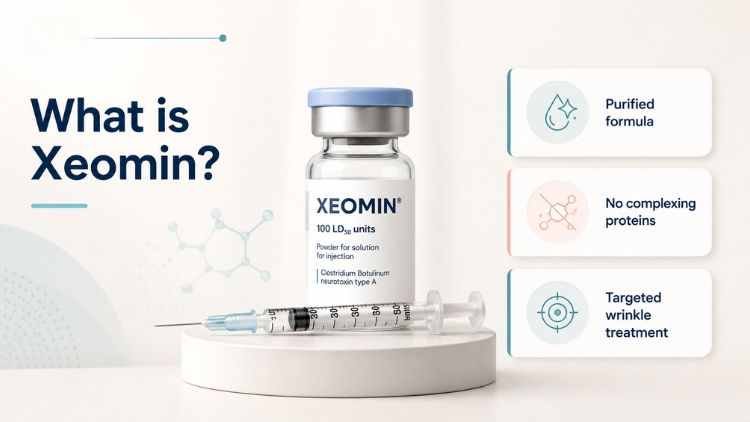
Xeomin is a botulinum toxin type A injectable used to temporarily relax targeted facial muscles responsible for dynamic lines. It is manufactured by Merz, contains incobotulinumtoxinA without accessory complexing proteins, and is regulated in Australia by the TGA. It is typically considered for adults with frown lines, forehead lines and crow’s feet.
What is Xeomin?
This wrinkle-relaxing option works by reducing the signal between a nerve and a targeted muscle. When that signal is softened, the muscle contracts less strongly for a temporary period. This can reduce the appearance of movement-related lines while still allowing the practitioner to plan treatment around natural facial expression.
How the treatment works: Blocking nerve signals to relax muscles
The effect is temporary and gradually wears off as nerve signalling returns and muscle activity resumes. Most patients review their results around two weeks after treatment. When that signal is softened, the muscle contracts less strongly for a temporary period. This can reduce the appearance of movement-related lines while still allowing the practitioner to plan treatment around natural facial expression.
This effect is not permanent. Over time, nerve signalling gradually returns and muscle movement comes back. Many patients assess their result around the two-week mark, although timing can vary between individuals.
The “naked injectable”: What protein-free actually means
This treatment is sometimes called a “naked injectable” because it does not contain accessory complexing proteins around the active neurotoxin. This does not mean it has no ingredients at all. It means the active component is supplied without the additional protein complex found in some other botulinum toxin type A formulations.
Clinically, this matters most when discussing long-term treatment response. Some practitioners consider a protein-free botulinum toxin type A option for patients who have used other wrinkle-relaxing products for years and feel their usual treatment does not seem to work as predictably as before
Who makes Xeomin and where is it approved?
This treatment is manufactured by Merz. In Australia, TGA registration information lists incobotulinumtoxinA as the active ingredient and includes adult upper facial lines among its indications, including glabellar frown lines, lateral periorbital lines and horizontal forehead lines.
This registration detail should not be read as a recommendation for every patient. Botulinum toxin treatments are prescription-only in Australia, so suitability should be assessed by an appropriately trained health practitioner during consultation.
Medical overview of botulinum toxin type A treatment
What areas can the treatment treat?
A protein-free botulinum toxin type A treatment is most relevant to movement-related upper facial lines in adults, especially frown lines, crow’s feet and forehead lines. Other areas may be discussed in clinical practice, but those uses need to be clearly assessed case by case and should not be treated as automatic or suitable for everyone.
TGA-approved uses: Frown lines, forehead lines, crow’s feet
The main cosmetic areas patients ask about are usually upper-face concerns. Frown lines can create a tense or tired look between the brows. Forehead lines may appear when the brows lift. Crow’s feet form around the outer eye area when smiling or squinting.
This wrinkle-relaxing option may help soften the appearance of these dynamic lines when the right muscles are selected and dosing is planned carefully. The aim is usually a fresher and more relaxed look, not a frozen or identical result for every face.
Off-label applications: Jaw slimming, lip lines, neck bands, hyperhidrosis
Some practitioners may discuss botulinum toxin type A for other concerns, such as jawline slimming, lip lines, neck bands or excessive sweating. These are clinical decisions that depend on anatomy, muscle strength, medical history and whether the treatment is appropriate for that concern.
For example, jaw concerns require assessment of the masseter muscles, bite pattern and facial proportions. TAEGA explains this broader consultation pathway in its guide to jaw slimming with botulinum toxin, where the focus is on suitability rather than choosing a product first.
Common facial zones treated with wrinkle relaxing injections
Xeomin vs Botox: The key differences, side by side
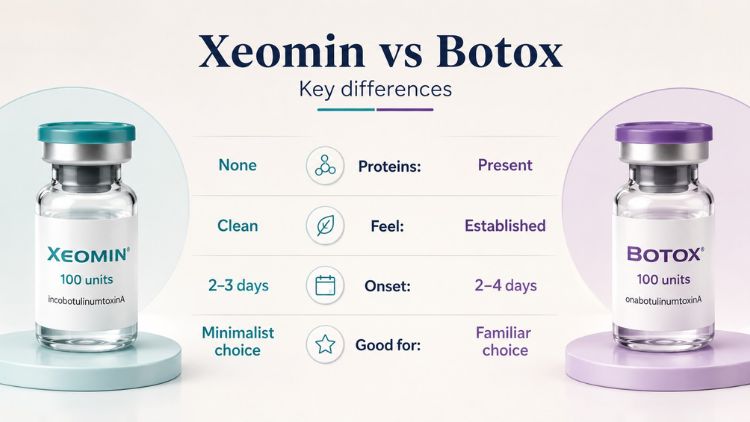
This comparison vs Botox usually comes down to formulation, treatment history, practitioner preference, and patient response. Both are botulinum toxin type A products, but one is free from accessory complexing proteins, while the other is the more established reference brand with long clinical familiarity
Comparison point | Xeomin | Botox |
Active ingredient type | Botulinum toxin type A | Botulinum toxin type A |
Formulation | Lacks accessory complexing proteins | Includes complexing proteins |
Common cosmetic discussion | Upper facial dynamic lines | Upper facial dynamic lines |
Onset | Commonly starts within several days | May show initial effects within several days |
Duration | Commonly around 3 – 4 months | Commonly around 3 – 4 months |
Dosing | Practitioner-planned; not for self-conversion | Practitioner-planned; not for self-conversion |
Storage | Different clinic storage requirements | Different clinic storage requirements |
Best assessed by | Consultation history and prior treatments | Clinical consultation and treatment record |
Formulation: proteins vs no proteins – Why it matters clinically
The main difference is not that one product is universally stronger. The defining factor is the formulation One formulation contains incobotulinumtoxinA without accessory complexing proteins, while Botox contains onabotulinumtoxinA in a different formulation.
This may matter for patients who have had many treatments over time. In rare cases, the body may develop a reduced response to a botulinum toxin product. A practitioner may then review dose, placement, timing, muscle strength and product choice before deciding whether a switch is worth considering.
Onset and duration: How quickly they work and how long they last
Both Xeomin and Botox usually take effect gradually. Some people notice early changes within a few days, but the result is often reviewed more meaningfully after about two weeks. Duration is commonly around three to four months, although it can vary.
Factors such as muscle strength, dose, treatment area, metabolism, exercise patterns and previous treatment history may affect longevity. For a broader overview of treatment planning, TAEGA explains the consultation approach behind anti-wrinkle injections at TAEGA Melbourne.
Dosing and unit equivalence: is the conversion 1:1?
Patients should not try to compare or convert botulinum toxin type A units themselves. Although some clinical discussions describe similar unit planning between certain formulations, dosing remains product-specific and patient-specifi
A practitioner considers muscle activity, asymmetry, previous response, facial proportions and the area being treated. This is why two patients with the same concern may receive different treatment plans, even when the same product is used.
Cost comparison in Australia: what to expect per session
The cost of this injectable in Australia can vary by clinic, practitioner, treatment area and number of units used. However, publishing a simple per-unit price can be misleading because it does not explain suitability, dosing, safety checks or whether the treatment is appropriate for the patient.
A consultation-based quote is usually more useful. It allows the practitioner to assess the area, explain realistic expectations and discuss whether a wrinkle-relaxing injectable, another treatment type, or no injectable treatment is the better option.
Storage and clinic availability: Is this treatment widely available in Melbourne?
A botulinum toxin type A product may have different storage characteristics compared with other formulations, but this is mainly a clinic logistics consideration. It should not be the main reason a patient chooses one option over another
Availability can vary between Melbourne clinics. The more important question is whether the clinic has a qualified practitioner who can explain the treatment options, assess your facial movement and guide you away from choices that do not suit your anatomy or goals.
Comparison chart of two wrinkle relaxing injectable treatments
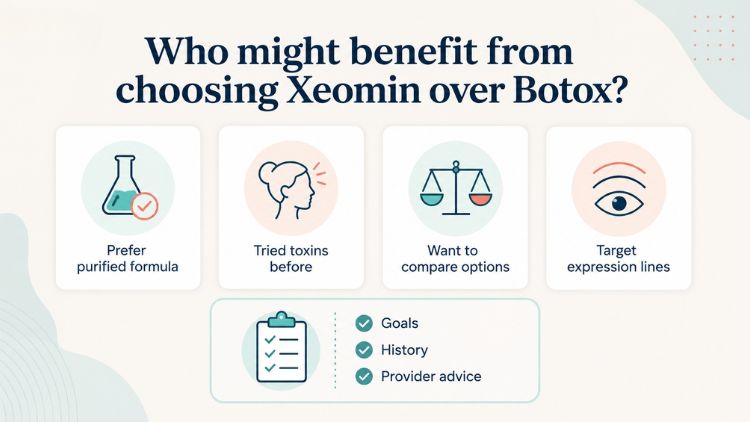
Who might benefit from choosing Xeomin over Botox?
A protein-free botulinum toxin type A option may be considered for patients who want to understand this category of treatment, especially if they have a long treatment history or feel their usual wrinkle-relaxing treatment is less predictable. It should be framed as a clinical decision, not a consumer upgrade
Long-term Botox users noticing reduced effectiveness
Some long-term Botox users report that their usual result does not seem to last as long or appear as consistent as before. This does not automatically mean Botox has stopped working. Muscle strength, dose changes, injection placement, treatment intervals and lifestyle factors can all influence the result.
In selected cases, a practitioner may discuss whether a protein-free botulinum toxin type A option is worth considering because of its formulation. The decision should be based on assessment, not on the assumption that switching brands will always improve the outcome.
Patients with sensitivities or protein allergies
Patients with a history of sensitivities may ask whether a protein-free botulinum toxin type A option is gentler because it does not contain accessory complexing proteins. The answer needs caution. A protein-free formulation may reduce exposure to those particular accessory proteins, but allergic reactions or side effects are still possible with any prescription medicine.
Your practitioner should review allergies, previous treatment reactions, medications, medical conditions and pregnancy or breastfeeding status before treatment. This step matters more than choosing a product based on a single formulation feature.
First-time patients curious about the protein-free option
First-time patients sometimes ask whether starting with a protein-free botulinum toxin type A option is better than starting with other established formulations. There is no universal answer. If your main concern is frown lines, forehead lines or crow’s feet, the treatment plan should begin with facial assessment and expectation setting.
For patients mainly concerned about the area between the brows, TAEGA’s guide to frown lines treatment in Melbourne explains how this concern is assessed before any product decision is made.
Patient suitability considerations for wrinkle relaxing treatments
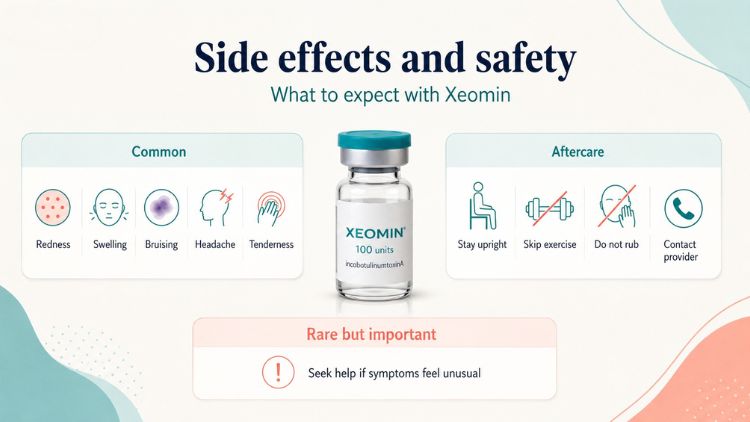
Side effects and safety: What to expect with Xeomin
Both botulinum toxin type A treatments have comparable safety considerations. Short-term effects may include redness, tenderness, swelling, bruising or headache, while less common risks depend on the treatment area and individual health history.
Common short-term side effects
After treatment, some patients may notice mild redness, pinpoint swelling or tenderness at the injection sites. Bruising can occur, especially if the area has many small blood vessels or if the patient bruises easily.
Headache, temporary heaviness or asymmetry can also occur. These possibilities should be discussed before treatment so you understand what is expected, what is uncommon and when to contact the clinic for advice.
Who may need to avoid this treatment option
A botulinum toxin type A treatment may not be suitable for people who are pregnant, breastfeeding, allergic to botulinum toxin ingredients, or living with certain neuromuscular disorders. It may also be unsuitable if there is an active infection near the planned injection area.
A careful consultation should include your medical history, current medications, previous injectable treatments and treatment goals. This protects you from being guided by product marketing when the safer answer may be to delay treatment or consider another option.
Common safety profile of botulinum toxin type A treatments
What to expect at your appointment at TAEGA
An appointment for a botulinum toxin type A treatment should begin with consultation, not injection. At TAEGA, the focus is to understand your goals, facial movement, previous treatment history and suitability before discussing whether a specific option or another treatment is appropriate for your concerns.
Consultation-based personalised treatment planning
Your practitioner will usually ask what bothers you, how long you have noticed the concern and whether you have had wrinkle-relaxing treatments before. They may observe your face at rest and during movement, such as frowning, smiling or raising your brows.
This is also the right time to discuss other injectable categories if you are unsure what your concern needs. TAEGA’s article on Botox versus collagen stimulators may help you understand why muscle-relaxing treatments and collagen-supporting treatments are not used for the same purpose.
The injection process: what it feels like and how long it takes
The injection step is generally short. Many appointments take around 10–20 minutes after the consultation and treatment plan are confirmed. The sensation is often described as a small pinch or quick sting, though comfort varies between patients.
Your practitioner will mark or identify the treatment points based on muscle movement. The aim is controlled placement, appropriate dosing and a result that suits your expression pattern.
Aftercare during the first 24 – 48 hours post-treatment
Aftercare is usually straightforward but essential. Your practitioner may advise you not to rub the treated area, avoid lying flat for several hours and skip vigorous exercise on the day of treatment.
You should also avoid massaging the area unless your practitioner specifically instructs you to do so. If you notice anything that feels unusual, contact TAEGA so the team can guide you on the next step.
FAQs
Frequently asked questions about Xeomin help patients better understand how the treatment works, who it may suit and what to expect before booking a consultation:
Is Xeomin available at clinics in Melbourne?
This treatment may be discussed at some Melbourne aesthetic clinics, but availability and suitability should be confirmed during consultation. Because botulinum toxin products are prescription-only in Australia, the more important question is whether a qualified practitioner can assess your face, medical history and goals before recommending any product.
How much does a botulinum toxin type A treatment cost in Australia?
The cost of the treatment in Australia can vary by clinic, practitioner, treatment area and the number of units required. However, publishing a simple per-unit price can be misleading because it does not reflect suitability, dosing, safety assessment or whether the treatment is appropriate for the individual patient.
Can I switch from Botox to Xeomin between appointments?
Some patients can discuss switching between botulinum toxin type A formulations, especially if their usual result feels less consistent. However, switching should not be done casually. Your practitioner should review your previous dose, timing, response, treatment area and medical history before deciding whether a different formulation is appropriate.
Does this treatment hurt more or less than Botox?
Both botulinum toxin type A treatments are usually delivered with very fine needles, so discomfort is often brief and comparable. Sensation depends more on the treatment area, injection technique and individual sensitivity than the brand alone. Your practitioner can explain comfort measures before treatment if needle anxiety is a concern.
Is this treatment safe for sensitive skin or allergies?
A protein-free botulinum toxin type A formulation may be relevant for some patients, but it does not remove all risk of reaction. People with allergies, sensitive skin, neuromuscular conditions, pregnancy, breastfeeding or previous injectable reactions should be assessed carefully before treatment. Only a qualified practitioner can confirm suitability
What if a botulinum toxin treatment doesn’t last as long as expected?
If the treatment does not last as long as expected, your practitioner may review the treated area, dose, muscle strength, timing and your previous response. Each individual may see different outcomes. A follow-up review helps determine whether the plan needs adjustment or whether another approach may suit you better.
Should you choose a protein-free botulinum toxin option or Botox?
Both are botulinum toxin type A products used to temporarily soften selected movement-related lines. Xeomin’s protein-free formulation makes it a useful option to understand, especially for patients comparing brands or reviewing a long treatment history.
The better choice is not decided by a blog article. It depends on your facial movement, previous response, goals, medical history and practitioner assessment. Book a consultation at TAEGA to discuss which wrinkle-relaxing option, if any, suits your anatomy and treatment goals.