
Dysport: What It Is, How It Works, and How It Differs from Botox
If you’ve been researching anti-wrinkle injections in Melbourne, you’ve likely come across two names: Botox and Dysport. Both are botulinum toxin treatments, but they’re not identical. This guide explains how it works and what sets it apart from Botox so you can have a more informed conversation at your consultation.
What is Dysport?
It is a prescription botulinum toxin type A treatment used to temporarily reduce targeted muscle movement. In cosmetic settings, it is commonly discussed for dynamic lines that appear with repeated facial expression, such as frown lines, forehead lines and crow’s feet.
The science behind the name
Dysport is scientifically known as abobotulinumtoxinA. It belongs to the botulinum toxin type A family, the same broad treatment category as Botox, although the formulation is different.
In simple terms, it uses a purified protein to interrupt the signal between a nerve and a selected muscle. When that muscle relaxes temporarily, the skin above it may look softer while the effect is active.
This does not mean every line should be treated the same way. Some lines are primarily caused by repeated muscle movement. Others are linked to skin quality, volume change, sun exposure or natural ageing. That is why a consultation matters before deciding whether anti-wrinkle injections are appropriate.
What treatment may be used to treat
It may be considered for cosmetic concerns such as frown lines, forehead lines, crow’s feet and neck bands. In some clinical settings, botulinum toxin treatments may also be discussed for functional concerns such as excessive sweating, jaw clenching or TMJ-related muscle tension.The right use depends on your anatomy, medical history, treatment goals and the practitioner’s assessment. A helpful consultation does not start by choosing a product. It starts by understanding what is causing the concern and whether an injectable option is suitable.
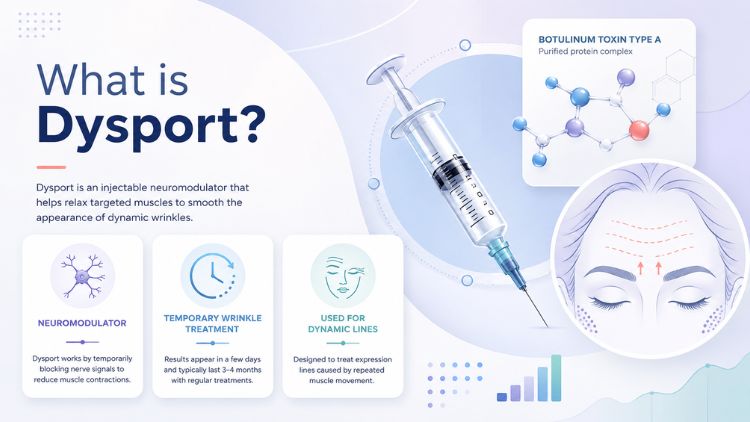
Treatment commonly discussed for dynamic facial lines
How Dysport works
The treatment works by blocking the release of acetylcholine, a chemical messenger involved in muscle contraction. When the targeted muscle receives less signal, it relaxes temporarily, which can soften expression-related lines while preserving an assessment-led, natural-looking approach.
Blocking the nerve signal
Muscles move when nerves send messages to them. It temporarily reduces that signal at the neuromuscular junction, which is the meeting point between the nerve and the muscle.
This effect is localised to the treated area when administered appropriately. It does not freeze the whole face. Instead, the practitioner places small amounts into specific muscles based on your facial movement, strength and treatment goals.
This is why technique matters. The same product can create different outcomes depending on the dose, placement, treatment area and your individual muscle pattern.
Onset, duration, and what the body does next
Many patients notice visible softening within about 2 – 3 days after treatment. The full effect is usually assessed at around two weeks, because the result continues to settle during that period.
The effect is temporary. For many people, results last around 3 – 4 months, although this varies with metabolism, muscle activity, treatment area and previous response. As the body gradually restores nerve signalling, movement returns and the result fades naturally.
Repeat treatment timing should be discussed with a qualified practitioner. In many cases, appointments are spaced at least 90 days apart, depending on clinical suitability.
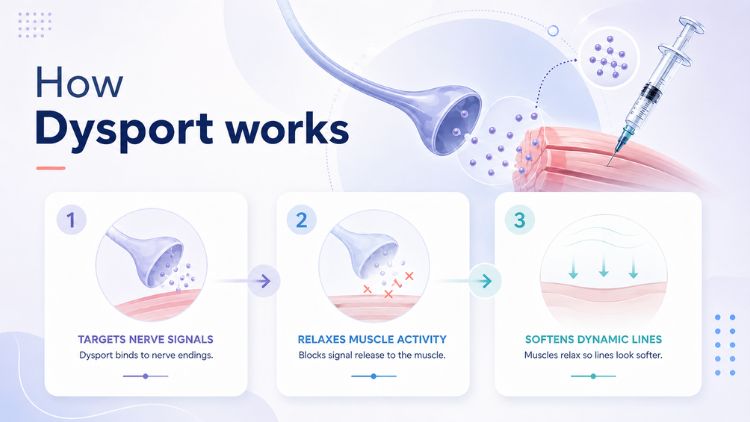
Diagram of muscle relaxation after Dysport treatment
What to expect: The treatment experience at TAEGA
At TAEGA, the treatment starts with consultation rather than product selection. The team reviews your facial movement, goals, medical history and suitability before discussing whether Dysport, Botox, another anti-wrinkle option or no injectable treatment is more appropriate.
Consultation first
Your consultation is where the important decisions happen. TAEGA assesses how your face moves at rest and during expression, then considers the areas that concern you.
This step also helps identify whether the line is mainly dynamic or whether other factors are involved. For example, a forehead line may be related to muscle activity, but it can also reflect skin texture, hydration, volume change or brow position.
You will also be asked about relevant medical history, allergies, pregnancy or breastfeeding, medications and previous injectable experiences. This helps the practitioner decide whether treatment is suitable and what risks should be discussed.
The procedure itself
An appointment is usually short, often around 10 – 20 minutes once consultation and planning are complete. The procedure involves micro-needle injections into selected points, based on the treatment area and your movement pattern.
Most patients describe anti-wrinkle injections as tolerable. Numbing is usually not required, but comfort can be discussed before treatment. After the appointment, many people return to normal daily tasks on the same day.
For the first 24 hours, your practitioner may ask you to avoid:
- Manipulating the treated area after injections
- Strenuous exercise
- Reclining immediately after treatment
- Heat exposure such as saunas or intense facial treatments
- Alcohol if it may increase bruising risk
At TAEGA, the treatment is administered by trained practitioners following a facial assessment and suitability review. The broader treatment pathway is explained through anti-wrinkle injections at TAEGA, including how consultation, treatment planning and aftercare fit together.
Who is a suitable candidate?
It may suit adults under 65 who are in good general health and have moderate to severe dynamic wrinkles caused by repeated muscle movement. Suitability still depends on individual assessment.
It may not be suitable if you are pregnant or breastfeeding, have certain neuromuscular conditions, have an infection at the injection site, or have a known allergy to botulinum toxin or cow’s milk protein. One formulation contains lactose, so this allergy detail should be discussed clearly during consultation.
You should also tell your practitioner about previous reactions, current medicines and any upcoming dental, medical or surgical procedures. These details can affect timing, suitability and treatment planning.

Consultation and treatment planning before injections
Dysport vs Botox: Which option may suit you?
Dysport vs Botox is not a question of one product being universally better. Both are botulinum toxin type A treatments, but they differ in formulation, dosing systems, diffusion behaviour, and onset patterns. The most appropriate choice depends on the treatment area, timeline, anatomy, and practitioner recommendation.
Comparison point | Dysport | Botox |
Scientific name | AbobotulinumtoxinA | OnabotulinumtoxinA |
Treatment category | Botulinum toxin type A | Botulinum toxin type A |
Typical onset | Often 2 – 3 days | Often several days |
Full effect | Around 2 weeks | Around 2 weeks |
Average duration | Around 3 – 4 months | Around 3 – 4 months |
Diffusion | May spread more widely | Often more localised |
Unit system | Different from Botox | Different from Dysport |
Better option? | Depends on assessment | Depends on assessment |
Shared treatment category, distinct formulations
Both treatments sit within the botulinum toxin type A category. Botox is known scientifically as onabotulinumtoxinA, while the other is known as abobotulinumtoxinA.
These formulations are not directly interchangeable. They have different protein structures, dosing systems and handling characteristics. This is why your practitioner does not simply swap one product for another using the same number of units.
The practical takeaway is simple: both treatments can be used for expression-related concerns, but the selection should be clinical. Your face, muscle strength, area treated and previous response all matter.
Diffusion: What “spreads more” actually means for patients
A formulation in this category is often described as having wider diffusion. This means it may spread a little more through the surrounding tissue after placement, depending on dose, dilution, injection depth and technique.
Wider diffusion can be useful in larger muscle areas. For example, the forehead, neck or underarm sweating areas may benefit from broader coverage when clinically appropriate. If you are comparing options for a forehead line treatment in Melbourne, diffusion is one of the points your practitioner may consider.
This does not make one formulation better for every area. Around small or precision-focused zones, a more localised approach may be preferred. The goal is controlled placement, not simply choosing the product that spreads more or less.
Onset speed: The treatment typically works faster
The treatment is often discussed for its faster visible onset. Many patients start noticing softening within 2 – 3 days, while Botox can take several days to become noticeable. Both typically reach fuller effect around two weeks.
This timing may matter if you are preparing for an event, photoshoot, wedding, travel or work commitment. However, faster onset does not mean it is automatically the better treatment. This is only one part of the decision-making process.
For planned events, timing should be discussed early. You still need time for assessment, treatment, settling and review. Leaving injectables until the last moment can make it harder to manage expectations.
Unit dosing: Why the numbers look different
The unit systems for the two treatments are not directly comparable. A higher number of units in one formulation does not mean the treatment is stronger, heavier or more aggressive.
A commonly used clinical comparison is that around 2.5 units may be considered roughly equivalent to 1 Botox unit, although dosing decisions should always be made by the practitioner. The conversion is not a pricing guide and should not be used to self-plan treatment.
Patients often have questions about this difference. When you see different unit numbers, you are often seeing a formulation difference rather than a difference in treatment intensity.
Duration and safety profile: Comparable across both
Both treatments usually last around 3 – 4 months for many patients. Duration varies because muscle strength, metabolism, treatment area, dose, and individual response are different for every person.
Possible side effects can include localised bruising, tenderness, swelling, headache or temporary heaviness near the treated area. Less common risks should be discussed before treatment, especially if the injection is near the eyes, brows, mouth or neck.
Neither product should be described as risk-free. A qualified practitioner should explain expected effects, possible side effects, aftercare and when to seek advice after treatment.
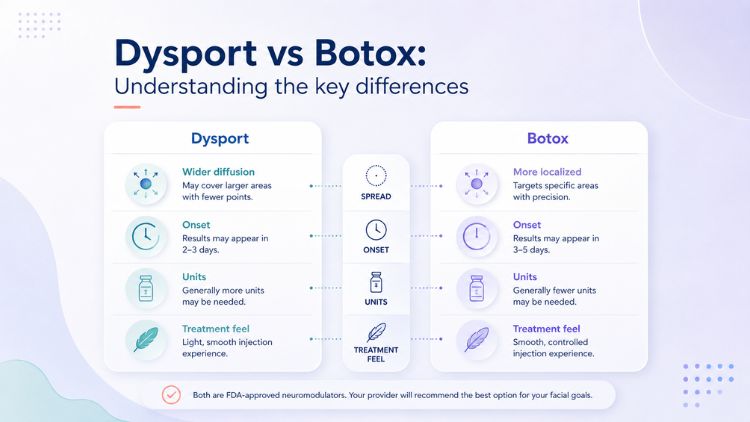
Comparison of Dysport and Botox treatment characteristics
Dysport or Botox: Which may suit you best?
Choosing between the two treatments should always be guided by a consultation rather than personal preference for a specific brand. Your treatment area, facial movement, timeline, previous response, and individual suitability all play a role in determining whether one option, the other, an alternative, or no injectable treatment is most appropriate.
If your main concern is frown lines, the discussion may focus on how strongly the muscles between the brows contract and how the area affects your expression. TAEGA explains this concern further through frown line treatment, including why assessment matters before planning injections.
Other factors may also guide the choice:
- The size of the treatment area
- Whether diffusion is useful or should be limited
- How quickly you hope to notice softening
- Your previous experience with botulinum toxin treatments
- Your comfort level with treatment and aftercare
- Existing medical conditions and treatment restrictions
A consultation at TAEGA is the clearest way to understand which treatment may suit your anatomy and goals. You do not need to arrive knowing which product to choose. The purpose of the appointment is to help you understand your options safely and clearly.
What practitioners consider when recommending treatment
The treatment area is often one of the first considerations. Larger areas, such as the forehead, neck or underarms, may require a different approach from smaller precision areas around the eyes or mouth. Diffusion, dose and placement all need to be planned carefully.
Your timeline can also play a role in treatment planning. One formulation is often discussed for a slightly faster visible onset, which may be helpful if you are preparing for an event. However, timing should still allow for consultation, treatment, settling, and a review period before any important occasion.
Previous response is another useful guide. If you have had either product before, your practitioner may ask how quickly it worked, how long it lasted and whether you noticed any heaviness, asymmetry or unwanted effects. This helps guide a safer and more personalised plan.
Why it’s a conversation, not a product selection
A blog article can explain the differences between Dysport and Botox, but it cannot assess your face in movement. The decision should be made with a practitioner who can review your muscle depth, facial dynamics, skin quality, treatment goals and any contraindications.
If your main concern is frown lines, the discussion may focus on how strongly the muscles between the brows contract and how the area affects your expression. TAEGA explains this concern further through frown line treatment, including why assessment matters before planning injections.
A consultation at TAEGA is the clearest way to understand which treatment may suit your anatomy and goals. You can discuss Dysport, Botox and other anti-wrinkle options through anti-wrinkle injections at TAEGA without needing to choose a product before your appointment.
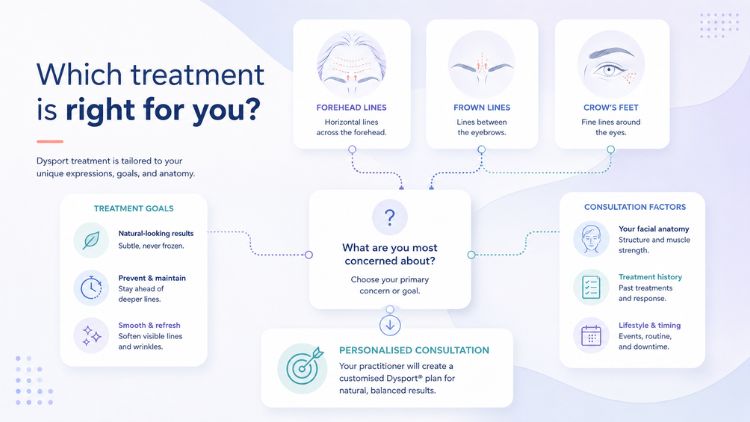
Treatment selection depends on anatomy, goals and assessment
FAQs
These frequently asked questions can help you understand this treatment more clearly before your consultation. They cover how it works, how long it may last, who it may suit, and how it compares with Botox.
Is the treatment available in Australia?
Yes. It is available in Australia and has been included on the Australian Register of Therapeutic Goods, with TGA records noting first registration on 16 June 2000. Botulinum toxin type A injectables are prescription-only medicines, so it should only be discussed, prescribed, and administered by a suitably qualified health practitioner after consultation.
How soon can you see results from Dysport?
Most patients notice early softening within about 2–3 days after treatment. The full effect is typically reviewed at around two weeks, as muscle relaxation continues to settle during that time. Timing can vary depending on the treatment area, dose, muscle strength, and individual response.
How long does this treatment last?
It commonly lasts around 3 – 4 months, although the duration is not the same for everyone. Results may fade sooner or last longer depending on metabolism, muscle activity, treatment area and previous treatment history. Your practitioner can explain when review or maintenance may be appropriate.
What is the key difference between Dysport and Botox?
The main difference between the two treatments lies in their formulation. One is formulated as abobotulinumtoxinA, while the other is onabotulinumtoxinA. The first is often associated with wider diffusion and a slightly faster visible onset, but this does not make it better for everyone. The most appropriate choice depends on your treatment area, goals, and clinical assessment.
Is this treatment used to treat excessive sweating (hyperhidrosis)?
Botulinum toxin injections may be used for excessive sweating, also called hyperhidrosis. Whether a specific botulinum toxin treatment or another option is suitable depends on the practitioner’s clinical assessment and the area being treated. TAEGA explains this pathway through excessive sweating treatment Melbourne.
Who should not get Dysport?
This treatment may not be suitable if you are pregnant or breastfeeding, have certain neuromuscular conditions, have an infection at the injection site, or have a known allergy to botulinum toxin or cow’s milk protein. Always share your full medical history during consultation so suitability and risks can be properly reviewed.
Talk to TAEGA about anti-wrinkle injection options
Dysport and Botox can both be part of an anti-wrinkle treatment discussion, but the right choice depends on more than the product name. Your facial movement, treatment area, timeline, medical history and comfort level all shape the recommendation.
Book a consultation with TAEGA to discuss whether a botulinum toxin treatment, an alternative option, or another approach may suit your goals. The team can assess your concerns, explain realistic expectations, and guide you through the next step without pressure