
Radiesse Vs Ellanse: How Collagen-Stimulating Fillers Differ
When comparing Radiesse vs Ellanse, both are collagen-stimulating injectable fillers used to address facial volume loss, wrinkles and skin quality concerns. Radiesse uses calcium hydroxylapatite, while Ellanse uses polycaprolactone microspheres in a CMC gel. Suitability depends on anatomy, treatment area, medical history, expected duration and local regulatory approval.
Understanding Radiesse vs Ellanse at a glance
Radiesse and Ellanse both provide immediate structural support and stimulate collagen, but they differ in ingredient, approved indications, longevity profile, reversibility and availability by country. Radiesse is CaHA-based and has FDA-approved uses in the US, while Ellanse is PCL-based and has EU-approved facial indications.
Criteria | Radiesse | Ellanse |
Main ingredient | A calcium hydroxylapatite-based material | Polycaprolactone, or PCL |
Carrier | CMC gel carrier | CMC-based gel |
Main action | Immediate support + collagen support | Immediate support + collagen support |
Typical duration | Often 12 – 24 months, variable | Often 1 – 4 years, market-dependent |
Reversible with hyaluronidase | No | No |
Common focus | Lower face, hands, jawline | Facial contour and ageing signs |
Best decision factor | Area, safety, indication, plan | Longevity goal and risk tolerance |
The key point is that neither product should be chosen from brand preference alone. Both are non-HA fillers, so planning needs to be more conservative than a simple “try it and dissolve it later” approach.
A consultation should clarify your anatomy, treatment goal, available products in your country and what your practitioner would do if the result is uneven or a delayed lump appears.
What is Radiesse?
Radiesse is a calcium hydroxylapatite-based injectable filler that provides immediate support under the skin and can stimulate collagen and elastin over time. In the US, official materials describe FDA-approved uses for moderate to severe facial wrinkles and folds, hand volume loss, décolleté wrinkles and Radiesse (+) for jawline contour in adults over 21.
Calcium hydroxylapatite, often shortened to CaHA, is a mineral-like material suspended in a gel carrier. The gel gives early structural support. The CaHA microspheres then act as a scaffold that may support collagen-related skin quality changes over time.
Official Radiesse materials list treatment areas such as lower face folds, hands and jawline, depending on the specific product and indication. The same page notes that Radiesse contains about 30% CaHA microspheres suspended in about 70% CMC gel carrier.
This does not mean Radiesse suits every face or every area. Local approval, skin thickness, injection depth, facial anatomy and the clinician’s plan all matter before treatment is considered.
What is Ellanse?
Ellanse is a polycaprolactone-based collagen-stimulating filler suspended in a CMC carrier gel. The gel provides initial filling, while PCL microspheres gradually degrade and support collagen formation. Its EU-approved intended use focuses on facial implantation for lasting correction of wrinkles and facial ageing signs.
Polycaprolactone, or PCL, is a biodegradable polymer used in some medical devices. In Ellanse, PCL microspheres sit within a CMC gel. The CMC component gives early volume, while the PCL component supports a longer collagen-stimulating effect.
The EU-approved intended use for Ellanse is subdermal implantation in the face. It is not a general “whole body” product, and it should not be treated as a universal solution for every contour or wrinkle concern.
A longer duration does not always mean a better outcome. It also requires a greater commitment to the result, the placement and any delayed issue that may arise.
Radiesse vs Ellanse: Key differences by mechanism
The main mechanism difference is the biostimulatory material. Radiesse uses CaHA microspheres, while Ellanse uses PCL microspheres. Both create an immediate structural effect, but their breakdown pathway, collagen response, labelled uses and expected maintenance plan are different.
Radiesse is often discussed as a calcium-based filler with a gel carrier. Ellanse is usually described as a PCL-based filler with a CMC carrier. Both sit outside the hyaluronic acid filler category.
The collagen phase also needs realistic wording. Collagen stimulation does not mean skin regeneration is guaranteed. It means the product may encourage a biological response that supports structure or skin quality, depending on placement, product, technique and patient response.
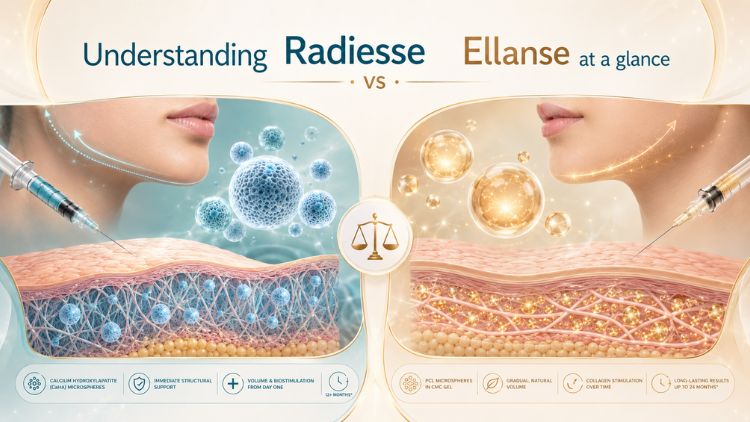
Side-by-side comparison of Radiesse and Ellanse fillers
Which lasts longer: Radiesse or Ellanse?
Ellanse is often positioned as longer-lasting because different PCL versions may be designed for varying durations. Radiesse is commonly discussed in the 12–24 month range depending on indication, area and patient response. However, duration should not be the only reason to choose a filler.
Some older clinical and product materials describe Radiesse results around 12–18 months, with longer improvement reported in selected studies. Ellanse clinical summaries describe sustained performance for certain versions up to 12 or 24 months, while some product materials discuss longer version-based durations.
Duration depends on more than the brand. It may change with treatment area, amount used, injection depth, metabolism, facial movement, product version and maintenance plan.
A longer-lasting product can be helpful for the right patient. It can also be less forgiving if your anatomy, preferences or facial proportions change. This may be an important consideration for first-time patients.
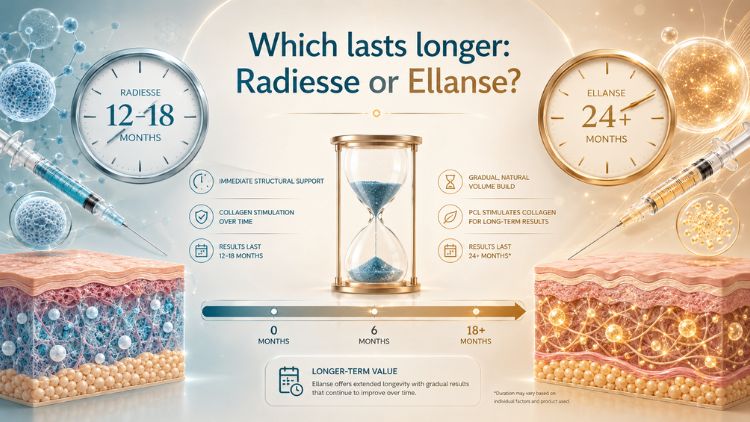
Longevity comparison between Radiesse and Ellanse treatment outcomes
Treatment areas: Where each option may be considered
Treatment area matters more than brand preference. Radiesse is often discussed for structural support, lower-face folds, hands, décolleté and jawline indications in some markets. Ellanse is mainly discussed for facial contour and ageing-related volume concerns. Delicate areas require extra caution and may need different options.
Concern or area | Radiesse consideration | Ellanse consideration | Caution |
Nasolabial folds | Labelled in some markets | May be considered for facial ageing | Avoid overcorrection |
Jawline or chin | Structural support may suit | Contour support may suit | Anatomy-dependent |
Hands | Stronger Radiesse indication in US | Less central comparison point | Check local approval |
Neck or décolleté | Depends on dilution and label | Usually not first comparison point | Higher caution |
Lips or under-eye | Usually not first-line | Usually not first-line | Consider alternatives |
The lips and under-eye area are especially delicate. A clinician may prefer a different product category, or may advise against treatment, depending on your anatomy and risk profile.
The neck also needs caution because of movement, thin skin and vascular anatomy. A careful consultation should explain what will be treated, what will be avoided and why.
Safety and side effects: What patients should understand
Both Radiesse and Ellanse can cause temporary swelling, redness, bruising, tenderness or lumps. Although uncommon, serious complications may occur if filler enters a blood vessel. A qualified injector, appropriate setting, informed consent and aftercare plan are central to reducing risk.
Common short-term reactions may include swelling, redness, bruising, tenderness, itching or pain at the injection site. These may settle within days to weeks, but the exact recovery window varies.
Delayed issues may include nodules, inflammation, infection, firmness or skin colour changes. These are not everyday outcomes, but patients should know they can happen before consenting to treatment.
The FDA warns that unintended injection into a blood vessel can lead to blocked blood supply, tissue necrosis, vision abnormalities including blindness, or stroke. Patients should seek urgent medical attention for unusual pain, vision changes, skin blanching, grey-blue skin changes or stroke-like symptoms.

Understanding potential risks and side effects of fillers
Reversibility: Can Radiesse or Ellanse be dissolved?
Radiesse and Ellanse are not hyaluronic acid fillers, so they are not dissolved with hyaluronidase in the same way HA fillers are. This makes assessment, conservative planning and injector experience especially important, because unwanted results or nodules may be harder to manage.
Hyaluronidase is mainly used to break down hyaluronic acid fillers. The FDA also notes that filler removal can require injections, surgery or other interventions, and that some filler materials may be difficult or impossible to remove.
This does not mean non-HA fillers should never be used. This requires careful consideration before treatment. The treatment plan should be precise, conservative and based on clear anatomy.
Reversibility matters most for patients who are new to injectables, unsure about facial changes or anxious about long-lasting results. In those cases, a shorter-duration or more easily reversible option may be discussed.
Cost comparison: Why price varies
Radiesse vs Ellanse cost varies by country, clinic, treatment area, amount used, practitioner qualification and review plan. A lower upfront price is not always cheaper long term, while a longer-lasting product is not always better if the treatment area or patient preference is unsuitable.
A quote should usually follow consultation. The clinician needs to assess the area, the amount required, product availability, appointment time, review schedule and any aftercare needs.
Cost can also reflect safety systems. These may include medical screening, sterile technique, emergency protocols, follow-up access and practitioner training.
For Australian publication, clinics should be careful with how pricing is presented for cosmetic injectable services. TGA advertising guidance should be checked before publishing cost-led claims or product-led promotional wording.
Who may suit Radiesse, Ellanse or neither?
Radiesse may be considered when immediate structural support and labelled areas align with the patient’s concern. Ellanse may suit patients who understand and accept a longer-lasting PCL-based plan. Neither may be suitable when medical history, pregnancy, active infection, unrealistic expectations or high reversibility needs are present.
- Radiesse may be discussed for patients seeking support in areas where CaHA has a relevant indication or clinical rationale. This may include lower-face structure, folds, hands or jawline support, depending on local rules.
- Ellanse may be discussed for patients who understand that PCL-based collagen stimulation can involve a longer commitment. The clinician should explain expected duration, alternatives and what happens if the outcome is not as expected.
- Neither option may suit patients with active infection, certain allergies, some bleeding risks, pregnancy or breastfeeding, or expectations that do not match what treatment can realistically achieve. Assessment by a qualified clinician should come first.
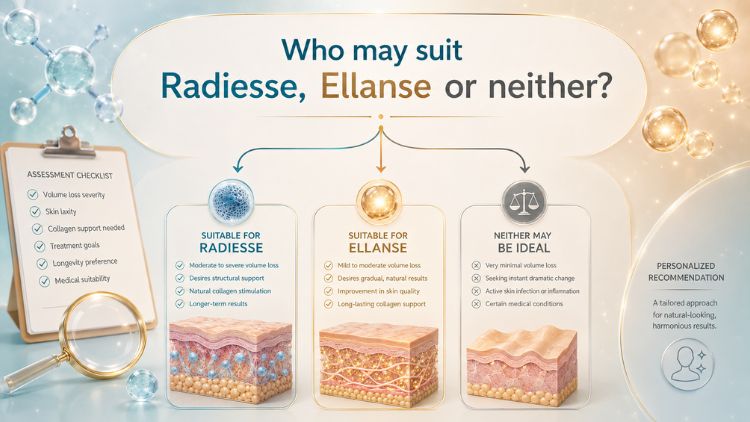
Patient suitability depends on goals anatomy and history
Questions to ask before choosing Radiesse or Ellanse
The best comparison happens in consultation, not from brand claims alone. Patients should ask about product approval in their country, ingredient, expected duration, alternatives, side effects, emergency protocols, aftercare and what happens if the result is uneven or a delayed lump appears.
Before choosing a collagen-stimulating filler, ask your clinician:
- What product and substance will be used?
- Is it approved or legally supplied in this country?
- Why is this option suitable for my anatomy?
- What areas will be treated and avoided?
- What side effects are common?
- What uncommon but serious risks should I understand?
- What is the aftercare plan?
- What is the review plan?
- What happens if I develop a lump or delayed inflammation?
- Are there alternatives with shorter duration or easier reversibility?
A good consultation should not make you feel rushed. You should leave understanding the benefit, the limit, the risk and the next step.
Radiesse vs Ellanse: Which one is better?
There is no universal “better” choice between Radiesse and Ellanse. The better option depends on the treatment area, local approval, desired longevity, skin quality, facial structure, medical history, injector experience and how comfortable the patient is with a non-HA, non-hyaluronidase-reversible filler.
Radiesse may be the more relevant discussion when the concern matches its labelled areas in your country. Ellanse may be more relevant when a longer PCL-based plan is appropriate and legally available.
The safest comparison is not “which filler lasts longer?” It is “which option, if any, fits this face, this area and this person’s comfort level?”
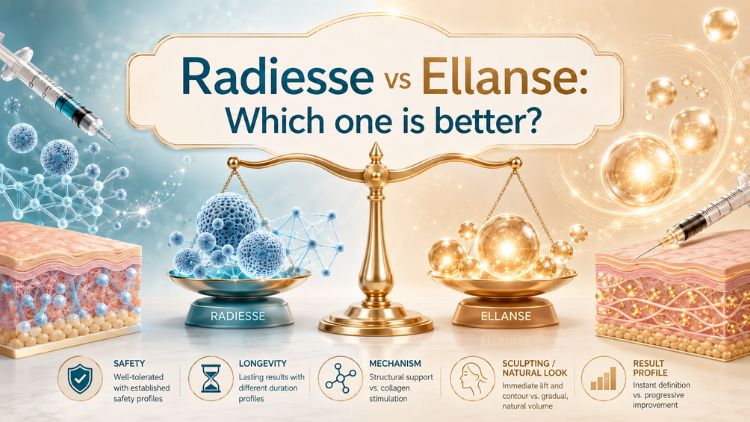
Choosing the most suitable filler for individual needs
FAQs about Radiesse vs Ellanse
Before comparing longer-lasting filler options, it helps to separate product claims from practical patient questions. These FAQs explain longevity, suitability, reversibility, side effects and consultation factors so you can discuss the right option with a qualified clinician more confidently.
Is Ellanse better than Radiesse?
Ellanse is not automatically better than Radiesse. Ellanse is often discussed for longer-lasting PCL-based collagen stimulation, while Radiesse is CaHA-based and has defined uses in some markets. The better option depends on treatment area, anatomy, product availability, medical history and risk tolerance.
Does Radiesse last longer than Ellanse?
Radiesse is commonly discussed in the 12 – 24 month range depending on indication and patient factors. Ellanse is often positioned across longer duration options depending on product version and market. Longevity varies, so duration should be discussed as an estimate rather than a guaranteed result.
Can Radiesse or Ellanse be dissolved?
Radiesse and Ellanse are not hyaluronic acid fillers, so they are not dissolved with hyaluronidase like HA fillers. This makes careful product selection, conservative planning and an experienced injector important, especially for first-time patients or people unsure about longer-lasting changes.
What are the main side effects of Radiesse and Ellanse?
Common side effects can include swelling, bruising, redness, tenderness or lumps at the injection site. Rare but serious complications may occur with intravascular injection, including skin or vision-related problems. Patients should receive clear aftercare instructions and know when to contact the clinic urgently.
How should I choose between Radiesse and Ellanse?
Start with a medical consultation rather than a product preference. A clinician should assess facial anatomy, treatment goals, medical history, previous procedures, suitability, product availability, expected duration and emergency protocols before recommending Radiesse, Ellanse or another option.
Conclusion
Radiesse vs Ellanse is best understood as a medical suitability question, not a simple brand comparison. Both are collagen-stimulating, non-HA fillers with different ingredients, indications, durations and reversibility limits. A consultation allows a qualified clinician to assess your anatomy, goals, medical history and treatment options before deciding whether a collagen-stimulating filler is appropriate.