
Radiesse Vs HarmonyCa: How To Compare Lift, Hydration And Collagen Support
Radiesse vs HarmonyCa are injectable collagen-supporting treatments for people noticing facial softness, early laxity or reduced definition. Radiesse uses calcium hydroxylapatite, while HarmonyCa combines hyaluronic acid with calcium hydroxylapatite. Suitability depends on the treatment area, skin quality, medical history, risk profile and consultation outcome.
What are Radiesse and HarmonyCa?
Radiesse and HarmonyCa are both discussed in the category of collagen-supporting injectables, but they are not the same treatment. Radiesse contains calcium hydroxylapatite, while HarmonyCa combines hyaluronic acid and calcium hydroxylapatite.
Radiesse
Radiesse is often considered when the treatment goal involves support, contour or restoring structure. In simple terms, it can help provide a scaffold-like effect in selected areas. Over time, the calcium hydroxylapatite component is associated with collagen stimulation.
HarmonyCa
HarmonyCa combines two familiar concepts in aesthetic medicine. Hyaluronic acid, often shortened to HA, is commonly discussed for hydration and soft volume. Calcium hydroxylapatite, often shortened to CaHA, is discussed for structural support and collagen stimulation. Official HArmonyCa material describes this as a dual effect: immediate lift from HA and a sustained effect associated with collagen production from CaHA.
However, product choice should never come before assessment. A practitioner needs to consider your facial structure, skin thickness, medical history, previous treatments and whether an injectable approach suits your concern.
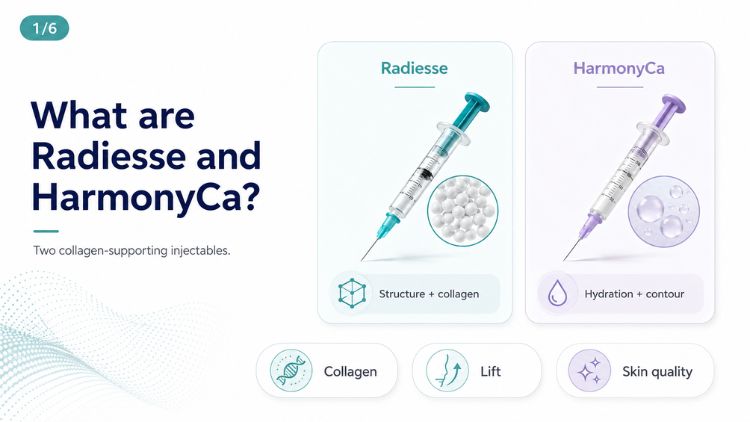
Radiesse and HarmonyCa collagen-supporting injectable treatment options
Radiesse vs HarmonyCa: Quick comparison
Radiesse may be discussed when firmer structure, contour or deeper facial support is the priority. HarmonyCa may be discussed when the goal includes softer volume, hydration and gradual skin quality support. The right choice still depends on anatomy, treatment area, previous injectables, risk profile and practitioner assessment.
Criteria | Radiesse | HarmonyCa |
Main composition | A gel carrier containing calcium hydroxylapatite | A blend of hyaluronic acid and calcium hydroxylapatite |
Common shorthand | CaHA injectable | Hybrid injectable |
Early effect | Structural support and volume effect | Soft volume, hydration and lift effect |
Gradual effect | Collagen stimulation | Collagen support plus HA hydration |
Texture goal | Firmer support | Softer, hydrated support |
Common discussion areas | Lower face, cheeks, folds, hands | Cheeks, lateral face, lower face |
Reversibility | Not an HA-only filler | Not treated like an HA-only filler |
Best next step | Clinical assessment | Clinical assessment |
Radiesse’s official instructions describe it as synthetic calcium hydroxylapatite suspended in a gel carrier. HArmonyCa’s official material describes it as a dual-action injectable combining hyaluronic acid and calcium hydroxylapatite.
This difference matters because the treatment plan is not only about how much volume is added. It is also about how the product behaves in tissue, how it supports the face, and how your body responds over time.
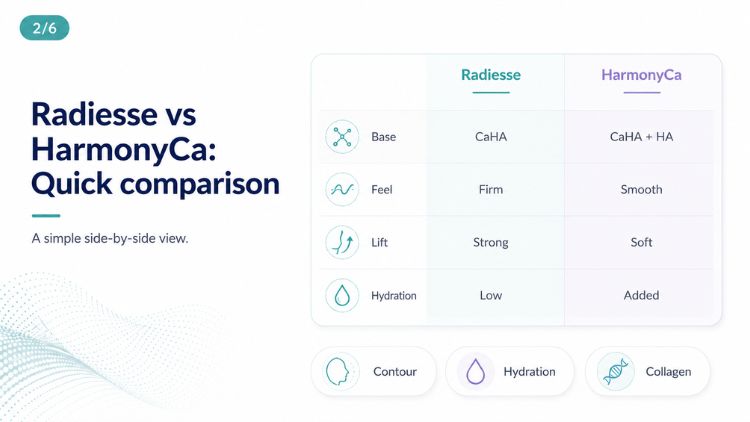
Comparing Radiesse and HarmonyCa across key treatment factors
How do Radiesse and HarmonyCa work under the skin?
Both treatments are often compared because they can support collagen-related changes, but they work in different ways. Radiesse relies on calcium hydroxylapatite in a gel carrier, while HarmonyCa combines hyaluronic acid with calcium hydroxylapatite in one injectable product.
Hyaluronic acid supports hydration and soft volume because it attracts and holds water. Calcium hydroxylapatite provides support and is linked with collagen stimulation. Collagen is a structural protein that helps skin feel firmer and more supported.
The early result and the gradual result are different parts of the same conversation. Some visible change may appear soon after treatment because the product has been placed into tissue. Collagen-related improvement usually develops more gradually.
For this reason, careful treatment planning is essential. The same product can look different depending on placement, amount used, injection depth, treatment area, age, skin quality and how your body responds.
Radiesse vs HarmonyCa for different patient concerns
The right comparison should begin with what you want to improve. Someone wanting stronger lower-face support may need a different conversation from someone noticing early laxity, skin dehydration or softer cheek volume.
Patient concern | Option to discuss | Why it may be considered |
Lower-face structure | Radiesse or another contouring plan | Often discussed for firmer support |
Softer cheek volume | HarmonyCa or another volumising option | HA component may support softness |
Skin quality and early laxity | HarmonyCa or a collagen-supporting plan | Combines moisture support with collagen stimulation. |
Facial folds and volume loss | Radiesse or alternative volumising care | May support selected deeper concerns |
Unsure first-time patient | Consultation before product choice | Suitability may change the plan |
This table offers a basic point of reference. It does not replace an in-person assessment, because facial ageing does not happen in one layer. Bone support, fat pads, skin quality, muscle movement and lifestyle factors can all affect the treatment plan.
If volume and facial balance are part of your concern, TAEGA’s volumising and reshaping treatments page explains how treatment planning can support facial proportions without aiming for an overdone look.
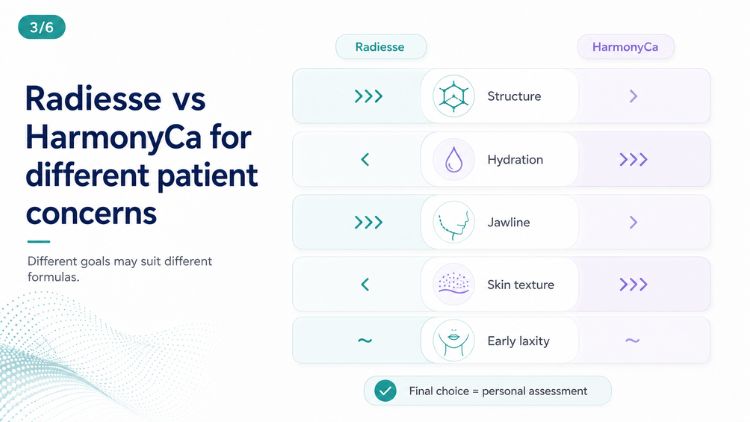
Treatment selection depends on individual concerns and goals
Treatment areas: Cheeks, jawline, lower face and hands
Radiesse and HarmonyCa are often compared for cheeks, jawline and lower-face support, but treatment areas should not be chosen from a table alone. A practitioner needs to assess anatomy, tissue quality, vascular risk and whether another option may be more appropriate.
- For the cheeks, the discussion often centres on support and softness. Some patients want a subtle lift through the mid-face. Others want to avoid extra fullness and may need a more conservative plan.
- For the jawline and lower face, structure becomes more important. Radiesse may be discussed when the goal involves firmer contouring support. HarmonyCa may be discussed when softness, hydration and skin quality are also part of the concern.
- Hands are a separate discussion. Radiesse has recognised indications in some markets, but treatment suitability, product availability and local regulations still need practitioner review. Your consultation should clarify whether the area is appropriate and whether another option is safer or more suitable.
Some areas need extra caution. The lips, under-eyes and areas close to important blood vessels need careful assessment. In some cases, TAEGA may recommend a different treatment or advise against injectable treatment.
Results timeline and longevity: What should you expect?
Some changes may appear early because both treatments can create an initial effect after placement. Changes linked to collagen tend to appear gradually. Duration varies between patients and depends on product choice, treatment area, dose, metabolism, lifestyle and the treatment plan.
This is where many online comparisons can become too simple. You may see fixed timelines such as 12 months, 18 months or 24 months. These numbers can be useful as broad context, but they should not be treated as a guarantee.
A better way to compare results is to separate three questions:
- What change may appear early?
- What change may develop gradually?
- How long might the result remain noticeable for your body and treatment area?
Radiesse is often discussed for structure and collagen support. HarmonyCa is often discussed for soft volume, hydration and collagen support. Both require realistic expectations because individual response varies.
During consultation, TAEGA can explain whether your concern is likely to need one treatment, staged treatment, maintenance, or a different approach.
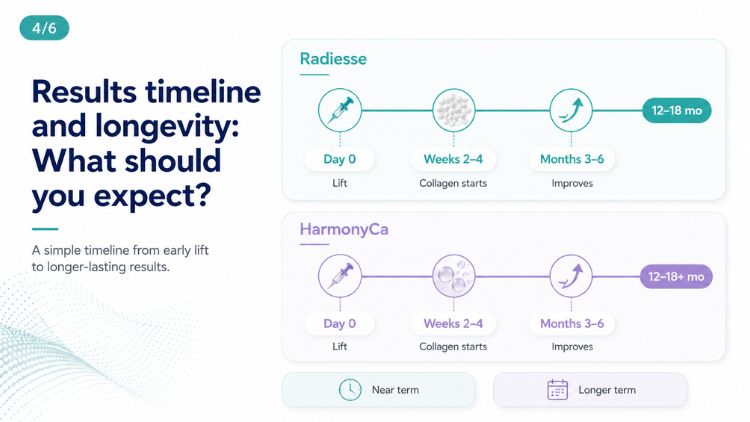
Results develop gradually and vary between individual patients
Safety, downtime and potential side effects
Swelling, redness, tenderness and bruising can occur after injectable treatments. Less common issues may include lumps, unevenness, infection or inflammatory reactions. Rare complications can be serious, especially if filler enters a blood vessel, so risks should be discussed before treatment.
The Radiesse instructions for use warn that intravascular injection of soft tissue fillers has been associated with rare but serious events, including vision impairment, blindness, stroke, skin necrosis and damage to underlying facial structures. The same document also notes short-term bruising, redness and swelling as injection procedure reactions.
You should contact your treating clinic promptly if you notice unusual pain, colour change, vision changes, severe swelling, or symptoms that feel different from the aftercare advice you received. These signs need timely review.
Suitability also matters. Some patients may not be suitable due to allergies, bleeding disorders, active infection, pregnancy, breastfeeding, medication use, previous complications, or other medical factors. A consultation helps identify these issues before a treatment plan is discussed.
Ahpra describes cosmetic injectables and dermal fillers as examples of higher-risk non-surgical cosmetic procedures in Australia. The regulator also states that advertising should be honest, balanced, realistic and informative, because these procedures can carry serious risks.
Can Radiesse or HarmonyCa be reversed?
Radiesse is not a hyaluronic-acid-only filler, and HarmonyCa is a hybrid product rather than a simple HA filler. Reversal, adjustment and complication management should be discussed with the treating practitioner before treatment, not after a problem appears.
This forms an important part of the consent process. Some patients hear that hyaluronic acid fillers can be dissolved and assume the same rule applies to all injectables. That is not accurate.
HarmonyCa contains hyaluronic acid, but it also contains calcium hydroxylapatite. Radiesse contains calcium hydroxylapatite as its key component. These differences affect how a practitioner thinks about planning, correction and risk management.
Before treatment, ask how the product behaves, what can be adjusted, and what the clinic does if a concern develops.
Cost in Melbourne: What affects the treatment price?
Cost depends on the area treated, the amount used, the complexity of the plan, practitioner assessment and whether review appointments are needed. For some medical aesthetic treatments, public pricing may also be affected by Australian advertising rules and clinic compliance requirements.
A lower price should not be the main reason to choose an injectable treatment. The more useful question is what the consultation includes, who performs the treatment, how suitability is assessed, and how aftercare is managed.
For general clinic cost context, TAEGA provides medical treatment pricing guidance. A consultation can explain what may affect your total cost and whether the treatment is appropriate for your goals.
Radiesse and HarmonyCa: Which one may suit you?
There is no single better option for every patient. Radiesse may be more relevant when structural support is the priority. HarmonyCa may be discussed when hydration, softer volume and skin quality are part of the concern. The final decision should follow clinical assessment.
Use this simple decision pathway before choosing any treatment:
- Identify the main concern: structure, volume, laxity, folds, hydration or skin quality.
- Decide whether you prefer firmer contour or softer support.
- Review previous injectables, reactions and medical history.
- Discuss downtime, bruising risk and comfort level.
- Weigh all options before deciding on treatment.
You do not need to choose the product before your appointment. In many cases, the consultation is where the safest and most natural-looking option becomes clearer.
If you want to compare other collagen-supporting options, TAEGA’s Ellansé vs Gouri vs Sculptra comparison can help you understand how different treatments are positioned.
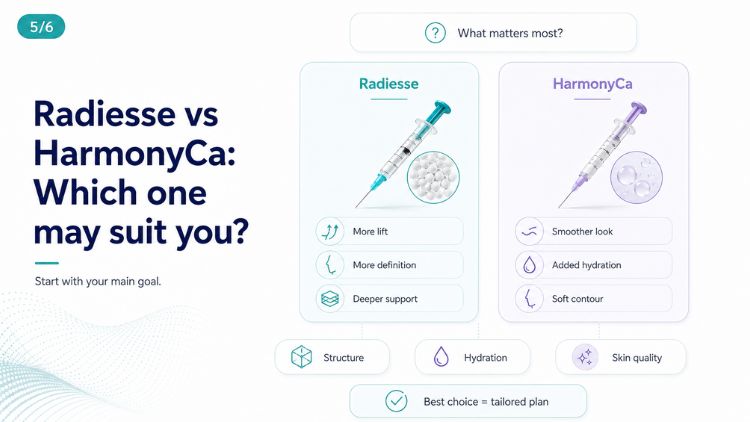
Choosing the right option based on treatment priorities
How TAEGA helps you compare collagen-supporting treatments
At TAEGA, the comparison starts with your face, skin and goals rather than a product preference. We assess your concern, medical history, previous treatments, skin quality, comfort level and suitability before explaining which options may be appropriate.
First-time patients may benefit especially from this approach. You may arrive thinking you need one product, but assessment may show that another treatment, a staged plan, or no injectable treatment is more suitable.
TAEGA focuses on natural-looking care, realistic expectations and clear aftercare. The aim is not to favour one treatment over another. The goal is to help you understand what each option can and cannot do.
Book a consultation with TAEGA to discuss whether Radiesse, HarmonyCa or another treatment may suit your facial structure, skin quality and comfort level.
FAQs about Radiesse vs HarmonyCa
Patients often ask about results, longevity, safety and suitability before choosing between Radiesse and HarmonyCa. These answers address some of the most common questions discussed during consultation:
Is Radiesse better than HarmonyCa?
Radiesse is not automatically better than HarmonyCa. Radiesse may be discussed when firmer structural support is the priority, while HarmonyCa may be discussed when hydration, softer volume and collagen support are part of the goal. The better option depends on your anatomy, treatment area, medical history and consultation outcome.
Which lasts longer, Radiesse or HarmonyCa?
Results duration varies from patient to patient. Online comparisons often describe both treatments in broad month ranges, but your result can be affected by treatment area, amount used, metabolism, lifestyle and product placement. A consultation gives a more realistic estimate based on your face, skin quality and treatment plan.
Does HarmonyCa work immediately?
HarmonyCa may create some early visible change because it contains hyaluronic acid as part of its hybrid formulation. Collagen-related change usually develops more gradually because calcium hydroxylapatite is associated with collagen support. Your practitioner should explain what may appear early and what may change over time.
Can Radiesse or HarmonyCa be dissolved?
Radiesse is not an HA-only filler, and HarmonyCa is a hybrid injectable that includes both HA and CaHA. This means reversal should not be assumed in the same way as a simple hyaluronic acid filler. Ask your practitioner about adjustment, complication management and safety planning before treatment.
How do I know which injectable is suitable for me?
You do not need to choose an injectable before your appointment. During consultation, TAEGA can assess your concern, medical history, facial structure, previous treatments and comfort level. We can then explain whether Radiesse, HarmonyCa, another collagen-supporting treatment, or a different option may be suitable.
Final thoughts on Radiesse and HarmonyCa
Radiesse vs HarmonyCa is not a simple “which one is better” decision. It is a question of structure, hydration, collagen support, treatment area, risk profile and how natural you want the result to look.
A careful consultation helps you compare both options in the context of your own face. That is the safest way to understand whether one treatment, another treatment, or no treatment is the right next step.
Book a consultation with TAEGA to understand which options may suit your goals, skin quality and comfort level.