
Xeomin vs Dysport – How To Choose The Right Anti-Wrinkle Injection
Xeomin vs Dysport are botulinum toxin type A injectable neuromodulators used in aesthetic medicine to reduce dynamic facial wrinkles by temporarily relaxing targeted muscles. Xeomin is protein-free, Dysport has a haemagglutinin complex, and they differ in diffusion, dosing units, and onset. Suitable for adults considering anti-wrinkle treatments under clinical assessment.
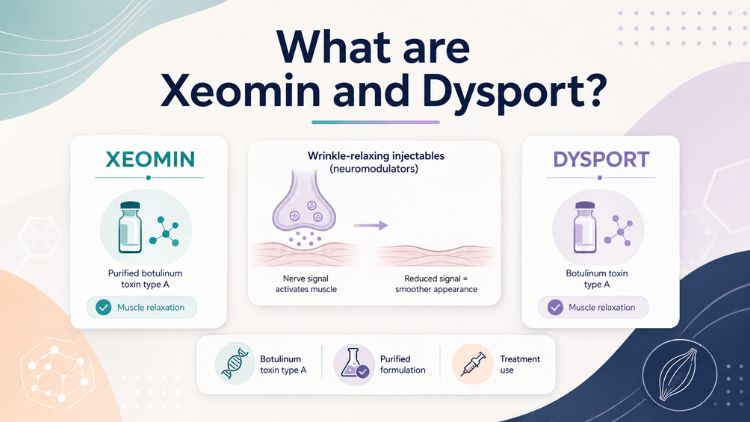
What are Xeomin and Dysport and how do they differ from Botox?
Xeomin and Dysport are both neuromodulators used to temporarily reduce selected muscle activity. They belong to the same broad treatment category as Botox, but each has its own formulation, unit scale and clinical behaviour. The choice is not about a universally superior product. It is about which option fits your anatomy, treatment area, goals and history.
Identical active ingredient, different product formulations.
Xeomin and Dysport both contain botulinum toxin type A. In simple terms, these treatments work by temporarily blocking the signal between selected nerves and muscles. When the treated muscle moves less strongly, movement-related lines can appear softer.
This does not mean the product “fills” a wrinkle. It does not create volume as dermal fillers do. It works on muscle movement, which is why practitioner assessment is important before choosing a product or dose.
Botox is another well-known brand in the same treatment category. However, the focus here is Xeomin vs Dysport, because their differences can matter for people comparing alternatives.
Xeomin’s key difference: The “naked” injectable
Xeomin is incobotulinumtoxinA by Merz. Its key formulation difference is that it contains purified neurotoxin without complexing proteins. This is why it is often described as a “naked” neuromodulator.
The protein-free formulation may be relevant for long-term or frequent injectable users. In some patients, clinicians may consider foreign protein exposure when reviewing reduced response over time. This does not mean Xeomin is automatically safer, stronger or more natural-looking than Dysport. It means the formulation may suit certain treatment histories.
Xeomin is often considered when precision matters. Smaller targeted areas, such as frown lines, crow’s feet, brow shaping or fine peri-oral movement, may benefit from a product that allows a controlled approach.
What makes Dysport different: Faster, broader diffusion
Dysport is abobotulinumtoxinA, a botulinum toxin type A product associated with Ipsen and Galderma in aesthetic markets. It is often discussed for its broader diffusion pattern and potentially earlier visible onset in some patients.
That broader spread can be useful when treating larger areas. For example, forehead lines, broader frontalis activity, neck bands or trapezius-related concerns may require more coverage across a wider muscle pattern.
However, diffusion is not only about the product. It also depends on dilution, dose, injection depth, placement and your anatomy. Experienced practitioners factor all of this into the treatment plan.
If you are comparing this treatment category in Melbourne, TAEGA explains what a botulinum toxin treatment in Melbourne may involve before you decide what to discuss during consultation.
Xeomin Dysport comparison with Botox mechanism explained in detail
Xeomin and Dysport: A side-by-side comparison
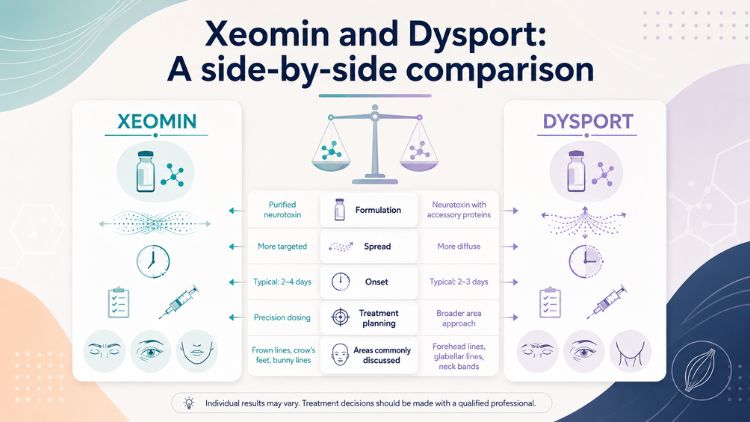
The clearest way to compare Xeomin vs Dysport is to look at formulation, onset, spread, duration and dosing. Both products can support natural-looking outcomes in experienced hands. The practical difference is how each product behaves in a specific area and how your practitioner adjusts placement and dose.
Decision point | Xeomin | Dysport | What it means for you |
Active ingredient | IncobotulinumtoxinA | AbobotulinumtoxinA | Same toxin type category, different formulation |
Protein content | Free from complexing proteins | Toxin-haemagglutinin complex | Xeomin may be considered for some repeat users |
Onset pattern | Commonly appears gradually within several days. | May appear sooner in some patients. | Dysport may suit time-sensitive planning |
Spread pattern | More targeted clinical profile | Broader diffusion profile | Treatment area size matters when choosing. |
Duration | Commonly similar, often around 3 – 4 months | Commonly similar, often around 3 – 4 months | Longevity depends on dose, area, and metabolism. |
Units | Product-specific units | Product-specific units | Unit pricing cannot be compared directly. |
Common planning areas | Frown lines, crow’s feet, brow lift, peri-oral | Forehead, broader frontalis, neck bands, trapezius | Practitioner technique remains the main factor |
Onset and duration: How quickly does each work and how long does it last?
Dysport is often chosen when a patient wants earlier visible softening, as some people notice changes sooner than with other neuromodulators. Xeomin can also begin working within the first few days, but many patients judge their final result closer to the two-week review point.
For both products, duration is usually discussed in months, not weeks. Many patients plan around a 3 – 4 month window, although this is not guaranteed. Muscle strength, area treated, dose, metabolism, lifestyle and previous treatment history can all affect how long results remain visible.
A practical approach is to avoid planning important events too close to treatment. Allow time for the product to settle, for any minor bruising or swelling to resolve, and for your practitioner to review symmetry if needed.
Diffusion and spread: Which is better for your target area?
Diffusion describes how treatment spreads from the injection point into nearby tissue. This is clinically useful when the goal is to soften a wider muscle area. It can also create risk if the product affects a muscle that was not intended to be treated.
Dysport’s broader spread may suit larger areas such as the forehead, frontalis and neck bands. When treating forehead movement, your practitioner needs to balance line softening with brow position. If forehead lines are your main concern, TAEGA has a separate guide to forehead lines treatment at TAEGA.
Xeomin may suit smaller areas where precision is important. This may include glabellar frown lines, crow’s feet, brow shaping, downturned mouth corners or fine lines around the mouth. The benefit is not that Xeomin is “better” for every small area. The benefit is that it gives the practitioner another controlled option.
Units and dosing: The conversion ratio explained simply
Xeomin and Dysport units are not the same. This is why comparing the price per unit can be misleading. A lower unit price does not automatically mean a lower total treatment cost.
In practice, some clinics use approximate planning ratios when comparing neuromodulators. You may hear that 1 Xeomin unit is roughly comparable to about 2.5 Dysport units in some cosmetic contexts. This should not be treated as a self-conversion rule.
The safer way to compare cost is by area and outcome plan. Ask what area is being treated, how many injection points may be needed, what result is being aimed for and when review is recommended. Your practitioner should calculate dosing based on your muscle activity, not a generic online ratio.
Side by side comparison of Xeomin and Dysport differences
Which patients are each treatment best suited for?
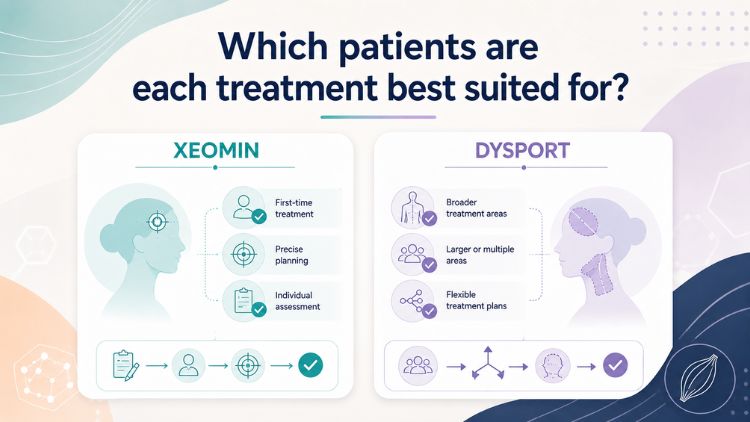
Xeomin may suit patients who want a more targeted approach or who have a long history of neuromodulator treatment. Dysport may suit patients treating broader areas or wanting earlier visible softening. Neither product is the right choice for everyone, and both require a consultation to assess suitability.
Xeomin could be the preferred option if…
Xeomin may be worth discussing if you have used neuromodulators for several years. If previous results seem to wear off sooner, feel less predictable or require more frequent review, your practitioner may consider formulation as one part of the assessment.
It may also suit patients who want precision in smaller treatment zones. These can include frown lines, crow’s feet, brow lift support, downturned mouth corners or fine movement around the mouth.
Patients who are sensitive to additives may also ask about Xeomin because of its protein-free formulation. However, suitability still depends on your medical history, medications, skin condition and treatment goals.
Dysport could be the preferred option if…
Dysport may be considered when you want broader softening across a larger muscle area. The forehead is a common example because the treatment needs to cover a wider movement pattern while preserving natural expression.
It may also be discussed when faster visible onset matters. For example, some patients prefer earlier softening before a planned event. Even then, treatment should not be left to the last minute because bruising, swelling and asymmetry review still require time.
Dysport can also be relevant for larger body or neck-related treatment areas. If you are comparing neuromodulator options for shoulder contour or muscle-related tension, the trapezius slimming treatment page explains that concern in more detail.
At TAEGA, our injectors will recommend the most appropriate neuromodulator based on your treatment area, movement pattern and goals during your consultation.
Can you use both at the same session?
In some cases, experienced practitioners may use different neuromodulators in different zones during the same appointment. This can make sense when one area needs broader coverage and another needs a more targeted approach.
This is not something to request by product name alone. The decision should come after an assessment of muscle depth, facial movement, asymmetry, treatment history and any contraindications.
A helpful consultation question is: “Which product suits this specific area and why?” This keeps the conversation focused on your anatomy and goals, rather than choosing based on online comparisons.
Which patients suit Xeomin or Dysport treatment options best
Safety profile, side effects, and treatment expectations
Xeomin and Dysport have broadly similar safety considerations because both belong to the botulinum toxin type A category. Common temporary effects may include bruising, swelling, tenderness or headache. More significant risks are usually related to dose, placement, patient selection and practitioner technique.
Shared side effect profile
Most injectable treatments can cause temporary effects at the injection site. You may notice small marks, tenderness, redness, swelling or bruising. Some patients also report a temporary headache or tight feeling as the treatment begins to work.
These effects are usually mild, but your clinic should explain what is expected and what is not. You should also receive aftercare instructions before leaving the clinic.
The most important safety factor is appropriate assessment. Your practitioner should ask about medical history, pregnancy or breastfeeding, allergies, medications, previous reactions and any neuromuscular conditions before treatment.
Diffusion-specific risk: the “drift” concern with Dysport
Because Dysport is often discussed as having broader spread, placement matters. If any neuromodulator affects a nearby muscle unintentionally, it can cause temporary issues such as eyelid heaviness, brow heaviness or uneven movement.
This is not simply a Dysport problem. Any botulinum toxin treatment can produce unwanted effects if it is placed incorrectly, overdosed or used in an unsuitable patient.
The difference is that broader spread requires careful planning around neighbouring muscles. This is why anatomy knowledge, conservative dosing and follow-up review are important.
Who should avoid either product?
Xeomin or Dysport may not be suitable if you are pregnant or breastfeeding. Treatment may also need to be delayed if you have an active skin infection, open wound, irritation or inflammation at the proposed injection site.
You should tell your practitioner if you have a neuromuscular condition, previous allergic reaction, swallowing or breathing issues, or any medication that may affect muscle or nerve function.
This list is not a substitute for medical assessment. It simply highlights why consultation matters before deciding between Xeomin vs Dysport.
If safety, suitability and practitioner technique are your main concerns, TAEGA explains its approach to anti-wrinkle injections at TAEGA Melbourne in more detail.

Safety side effects and expectations for Xeomin and Dysport
FAQs
Below are some frequently asked questions about Xeomin and Dysport to help you better understand how these two anti-wrinkle injectable treatments compare in terms of results, safety, and suitability:
Is Xeomin the same as Botox?
No. Xeomin and Botox both contain botulinum toxin type A, but their formulations differ. Xeomin contains incobotulinumtoxinA without accessory complexing proteins, which is why it is sometimes called a “naked” neuromodulator. Botox is a separate brand and product formulation. The mechanism is similar, but the products are not identical.
How long do Dysport results last compared to Xeomin?
Dysport and Xeomin results are often discussed within a similar duration range, commonly around 3 – 4 months. However, no specific duration is guaranteed. The treated area, dose, muscle strength, metabolism, previous treatment history and aftercare can all influence how long the visible effect lasts.
Is it possible to switch from Botox to Xeomin or Dysport?
Yes, switching from Botox to Xeomin or Dysport can be discussed during consultation. Some patients switch because they want a different onset profile, a different spread pattern or a review of reduced response over time. Your practitioner will assess your previous dose, treatment area and timing before recommending a new plan.
Is Dysport cheaper than Xeomin in Australia?
Dysport may have a lower per-unit price in some clinics, but it usually requires a different number of units because product units are not interchangeable. Xeomin and Dysport should be compared by treatment area and clinical plan, not by unit price alone. The total cost may be more similar than it first appears.
Does Dysport or Xeomin look more natural?
Both Dysport and Xeomin can support natural-looking results when the dose, placement and treatment area are planned carefully. Dysport may suit broader softening in larger areas, while Xeomin may suit smaller targeted zones. The final look depends more on practitioner technique and patient selection than the product name alone.
Common questions about Xeomin versus Dysport answered clearly
How to choose between Xeomin and Dysport
Xeomin vs Dysport is not a simple “better or worse” comparison. Xeomin may be considered for precision, protein-free formulation and long-term treatment planning. Dysport may be considered for broader areas, earlier visible onset and larger muscle patterns.
The right choice depends on your face, muscle movement, treatment history and goals. A consultation allows your practitioner to assess whether Xeomin, Dysport or another approach is the most suitable option.
Book a consultation at TAEGA to discuss whether Xeomin or Dysport fits your anatomy, lifestyle and treatment goals.